One of the most confusing moments in navigating senior care is realizing that “memory care” and “assisted living” are not the same thing — and that understanding the difference can determine whether your loved one receives care that is genuinely appropriate for their needs, or care that falls short in ways that only become visible after move-in.
Families researching senior living options in Palm Beach County and South Florida frequently encounter both terms and assume they represent two points on the same spectrum. In a narrow sense, that is true — memory care is a more intensive level of residential care than standard assisted living. But the differences go far deeper than intensity. They involve distinct physical environments, fundamentally different staffing models, specialized programming that serves a different cognitive population, and cost structures that reflect those differences. Understanding assisted living vs. memory care is not an academic exercise. It is the foundation of one of the most consequential decisions a family will ever make for a loved one.
This article defines both levels of care in plain terms, explains the transition point that signals when one becomes the right choice over the other, and gives you the questions that reveal whether a community’s “memory care” is a genuinely specialized program — or simply a locked wing of a standard assisted living facility.
Assisted living is a residential care setting for older adults who need help with activities of daily living — bathing, dressing, grooming, medication management, meals, housekeeping — but who do not require the continuous skilled medical nursing that a nursing home provides. It is designed for seniors who retain meaningful cognitive function and the ability to direct their own care, make decisions about their daily lives, and engage with their community in purposeful ways.
The core promise of assisted living is independence with support. Residents typically live in private apartments or suites, eat in a shared dining room, participate in social programming, and receive individualized help with the specific tasks that have become difficult. They can come and go — with appropriate supports — and they retain significant control over how their days are structured.
Assisted living is the appropriate level of care for seniors who:
Assisted living is not appropriate — and is genuinely unsafe — for seniors who wander, who cannot recognize danger in their environment, or whose cognitive impairment has progressed to the point where they cannot consistently direct their own care or respond appropriately to staff guidance.
Staff in assisted living communities provide personal care, medication assistance, and general supervision. They are trained in senior care broadly, but do not necessarily have specialized training in dementia communication techniques, behavioral de-escalation, or the neurological realities of Alzheimer’s disease progression. Staff-to-resident ratios in assisted living are typically lower than in memory care — meaning more residents per caregiver on any given shift.
This is not a flaw in assisted living. It reflects the appropriate level of supervision for the population it serves. A resident who is cognitively intact or mildly impaired does not require the intensive oversight that a resident with advanced dementia needs. The mismatch occurs when a resident with significant cognitive impairment is placed in an assisted living setting without the specialized support their condition requires.
Memory care is a specialized form of residential senior care designed exclusively for people with Alzheimer’s disease, vascular dementia, Lewy body dementia, frontotemporal dementia, or other forms of significant cognitive impairment. Every element of a purpose-built memory care community — the physical environment, the staffing model, the daily programming, the safety systems — is designed around the specific and evolving needs of this population. Our memory care placement services exist specifically to help families find communities that deliver on this promise, not just communities that use the term.
The design of a genuine memory care community is intentional from the ground up. Layouts are typically circular or looping — so residents can walk freely without reaching a dead end that triggers agitation or distress. Secure entrances, coded keypad exits, and alarmed doors prevent elopement without creating a prison-like atmosphere. Enclosed, landscaped outdoor spaces allow safe access to fresh air and natural light. Color coding, visual landmarks, and simplified wayfinding help residents navigate their environment without relying on memory that has been compromised.
These are not upgrades or amenities. They are clinical features that directly affect resident safety and behavioral health. A memory care unit that does not have secure outdoor access, robust wayfinding, and genuine anti-elopement systems is not a memory care community in any meaningful sense — it is an assisted living floor with a locked door.
This is where the most significant and consequential differences between assisted living and memory care emerge. A genuine memory care community maintains substantially lower staff-to-resident ratios than standard assisted living — particularly in the evening and overnight hours when behavioral symptoms peak and fall risk is highest.
More important than the ratio is the nature of the training. Memory care staff learn dementia-specific communication — how to speak with someone who can no longer process language sequentially, who may not recognize familiar faces, or who responds to emotional tone more than verbal content. They learn behavioral approaches: how to redirect without confrontation, how to de-escalate sundowning episodes, how to respond to repetitive behaviors with patience rather than correction. They learn how to read nonverbal cues from residents who can no longer articulate pain, fear, or confusion through words.
This training is not a weekend seminar. In well-run memory care communities, it is ongoing, regularly updated, and deeply embedded in the culture of how staff approach their work. When evaluating any community, ask how many hours of dementia-specific training staff receive before they begin working with residents — and how often that training is refreshed.
Programming in memory care is not simply a scaled-down version of assisted living activities. It is designed with explicit understanding of how cognitive impairment changes what is meaningful, accessible, and therapeutic for a resident at each stage of their disease.
Effective memory care programming includes:
A memory care community that cannot describe its programming in this level of detail — that speaks only generally about “activities” — is telling you something important about how seriously it takes this dimension of care.
Memory care costs more than standard assisted living — typically by a meaningful margin. This cost difference reflects the higher staffing ratios, the specialized training requirements, the more intensive physical environment, and the 24-hour behavioral supervision that genuine memory care requires. Families who are surprised by this difference are often families who assumed that any locked setting would cost roughly the same as an assisted living community with a higher care level.
In Palm Beach County and South Florida, the monthly cost of memory care in a quality community typically runs several hundred to over a thousand dollars more per month than comparable assisted living. But the comparison is not truly apples-to-apples — because a resident placed in assisted living who actually requires memory care will not receive appropriate supervision, will be at higher risk for falls and elopement, and is likely to require more frequent crisis interventions that come with their own costs.
Within memory care itself, cost structures vary. Most communities charge a base monthly rate that covers a defined level of care, with additional fees for higher care needs, incontinence supplies, medication management, and specialized programming. Asking for a complete itemized breakdown — and understanding what triggers a care level increase — before signing a contract is essential. Our
Within memory care itself, cost structures vary. Most communities charge a base monthly rate that covers a defined level of care, with additional fees for higher care needs, incontinence supplies, medication management, and specialized programming. Asking for a complete itemized breakdown — and understanding what triggers a care level increase — before signing a contract is essential. Our long-term care planning and consulting service helps families navigate these financial conversations with a clear picture of what they are actually getting for what they are paying.
This is the question families struggle with most — and delay answering longest. The shift from assisted living being the right level of care to memory care being the necessary level is not always sudden. It builds gradually, through a series of incidents and changes that are individually explainable but collectively significant. Our guide on when is it time for assisted living covers the signals for the first transition — from home to a care setting. The signals for the second transition — from assisted living to memory care — are equally important and often arrive more quickly than families expect.
Signs that a resident in assisted living may need memory care include:
Families who recognize these signs but delay acting — out of emotional difficulty, financial concern, or the hope that things will stabilize — often find themselves making a placement decision under crisis conditions, with fewer options and less time to evaluate them carefully.
The most important consumer protection skill a family can develop when evaluating senior care is the ability to distinguish genuine memory care from an assisted living community that has added a locked wing, called it memory care, and charged accordingly. This distinction is not always obvious from a tour. It requires specific questions, direct observation, and some knowledge of what the answers should sound like.
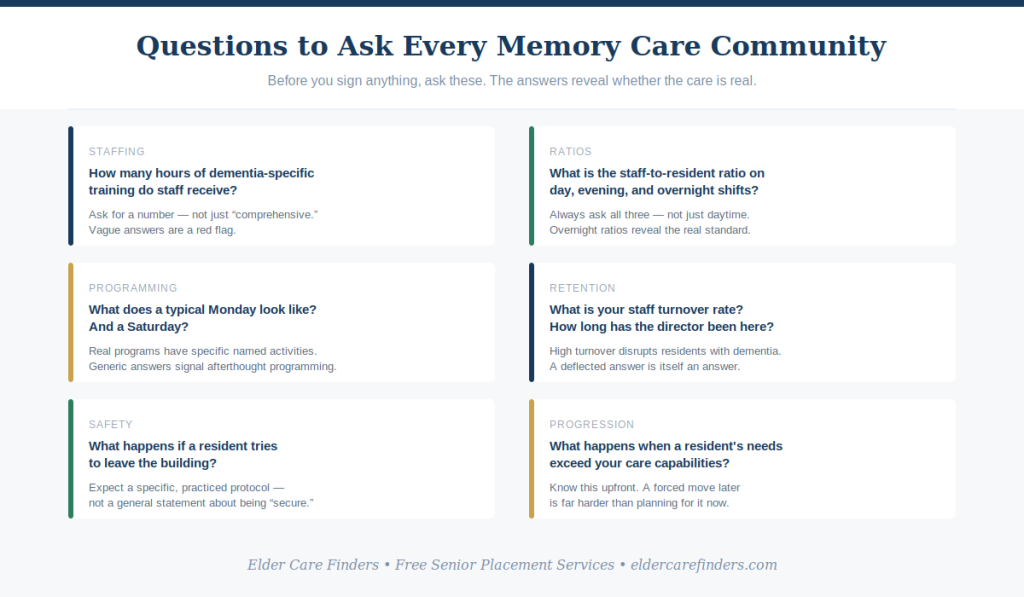
These questions should be asked of every memory care community you visit. The quality of the answers — the specificity, the confidence, the absence of deflection — tells you as much as the content:
These questions do not require medical expertise to ask. They require only that you ask them directly and pay attention to whether the answers are specific and confident or vague and deflecting.
The distinction between assisted living and memory care — and the decision about which is right for a specific person at a specific point in their disease — is exactly the kind of decision that benefits from expert, local guidance. Elder Care Finders has toured these communities. We know which ones have genuinely specialized memory care programs and which ones have added a locked wing to an assisted living building without meaningfully changing what they offer. Our senior living placement services are provided at no cost to families, because we are compensated by the communities we work with — which means you receive expert guidance with no out-of-pocket expense.
Our process begins with a thorough needs assessment. We ask about your loved one’s current cognitive stage, their behavioral profile, their medical needs, their personal history and preferences, and the practical parameters your family is working within — location, budget, timeline. From that assessment, we identify the communities that are genuinely the best match, not simply the communities that have availability.
We then accompany families on tours, help them ask the right questions, and interpret what they are seeing and hearing in the context of what we know about these communities from direct experience. We also help families understand when assisted living is still the appropriate level of care and when memory care has become necessary — a distinction that our evaluating memory care communities resource covers in depth.
After placement, we provide a five-day transitional support program, followed by monthly check-in visits and ongoing family communication. If care needs change — if a resident placed in assisted living eventually requires memory care, or if a memory care community reaches the limits of what it can provide — we are a resource for navigating that transition as well.
Assisted living and memory care sit in the middle of the senior living spectrum. For seniors who are largely independent and primarily want a maintenance-free lifestyle with community and optional services, independent living may be more appropriate than either. For seniors whose medical needs require continuous skilled nursing — wound care, IV therapy, post-surgical recovery, ventilator support — a nursing home may be necessary. Understanding where a loved one falls on this spectrum is part of what our placement process clarifies from the beginning.
The difference between assisted living and memory care is not just a matter of degree. It is a matter of whether the environment, the staff, the programming, and the safety systems are built specifically for someone whose cognitive function has been significantly compromised by disease — or whether they are built for someone who needs help with daily tasks but retains the ability to navigate their own care.
Getting this decision right matters enormously. A resident placed in memory care who only needed assisted living may find the environment over-supervised and isolating. A resident placed in assisted living who needed memory care may be unsafe, under-supervised, and receiving programming that is entirely mismatched with what would actually benefit them.
If you are trying to determine which level of care is right for your loved one, or if you are already facing the decision about whether a current assisted living placement is still appropriate, Elder Care Finders is ready to help. Our placement coordinators bring over 20 years of South Florida senior care experience to every family conversation. Contact us to schedule a free consultation — we will help you understand your options, ask the right questions, and find the community that is genuinely the right fit.
The material contained on this site is for informational purposes only and DOES NOT CONSTITUTE THE PROVIDING OF MEDICAL ADVICE, and is not intended to be a substitute for independent professional medical judgment, advice, diagnosis, or treatment. Always seek the advice of your physician or other qualified healthcare providers with any questions or concerns you may have regarding your health.