When your parent lives in South Florida and you live hundreds or thousands of miles away, choosing a senior community can feel like trying to make a life-changing decision through a screen. Online photos rarely show the full picture, prices are difficult to compare, and every community seems to describe itself in the same reassuring language.
For many adult children, finding assisted living for a parent in Florida from out of state begins with late-night searches and a long list of unanswered questions. The process becomes much more manageable when the family completes the assessment and screening remotely, uses a trusted local advisor as its eyes, and travels only after the choices have been narrowed to a few strong finalists.
Elder Care Finders helps out-of-state families explore independent living, assisted living, and memory care communities throughout Palm Beach, Martin, and St. Lucie Counties. Our senior living placement services are personalized to the older adult's needs, preferences, location, and budget—and provided at no cost to families.
Distance creates more than a travel problem. It creates an information problem. An adult child may know that Mom has fallen twice, Dad is skipping meals, or medication management has become confusing, but may not see the smaller changes that happen between phone calls.
At the same time, a senior living search involves several decisions at once:
A local search should answer those questions before a family books multiple flights or tours communities that were never realistic options.
The first step in finding assisted living for a parent in Florida is not choosing a building. It is creating an accurate picture of the person who may live there.
A useful remote assessment should consider:
Whenever possible, include your parent directly. A successful placement should preserve choice and independence, not reduce the senior to a checklist. If the family has concerns about cognition, mobility, or medical stability, a qualified healthcare professional should help determine what support is appropriate. A placement advisor can organize the search, but does not replace a clinical assessment.
Before tours begin, create one shared digital folder with the current medication list, physician contacts, emergency contacts, insurance information, recent care notes, financial parameters, and any power-of-attorney or healthcare decision documents the family already has. Each community will explain its own admission and documentation requirements, but organizing the basics early prevents avoidable delays.
A community appearing first online does not mean it is the best fit. The shortlist should be built from the needs assessment, current availability, care level, location, lifestyle, and the full expected cost.
Local geography matters in South Florida. Palm Beach County includes very different markets and lifestyles—from Palm Beach Gardens, Jupiter, and West Palm Beach to Boca Raton, Delray Beach, Boynton Beach, and Wellington. Families looking farther north may be considering senior living in Martin County, including Stuart, Hobe Sound, or Palm City, or options in St. Lucie County, including Port St. Lucie and Fort Pierce.
A strong shortlist is usually short for a reason. Three communities that genuinely fit are more useful than 15 attractive websites.
When assisted living is the likely choice, verify the facility through the Florida Agency for Health Care Administration's FloridaHealthFinder assisted living guide. Florida requires an assisted living facility to hold a standard license, and some communities hold additional licenses that permit specific services beyond the standard license.
The license type matters because a beautiful community may not be authorized or equipped to support the level of care your parent needs. FloridaHealthFinder can also help families review facility profiles, specialty licenses, inspection reports, complaints, sanctions, deficiencies, bed information, and other details.
Inspection records should be interpreted carefully and alongside other information. Look at the nature of any finding, whether it was corrected, whether similar concerns repeat, and how leadership responds when asked about it. Florida's Agency for Health Care Administration specifically advises consumers to use inspection results together with other sources rather than treating one report as the entire story.
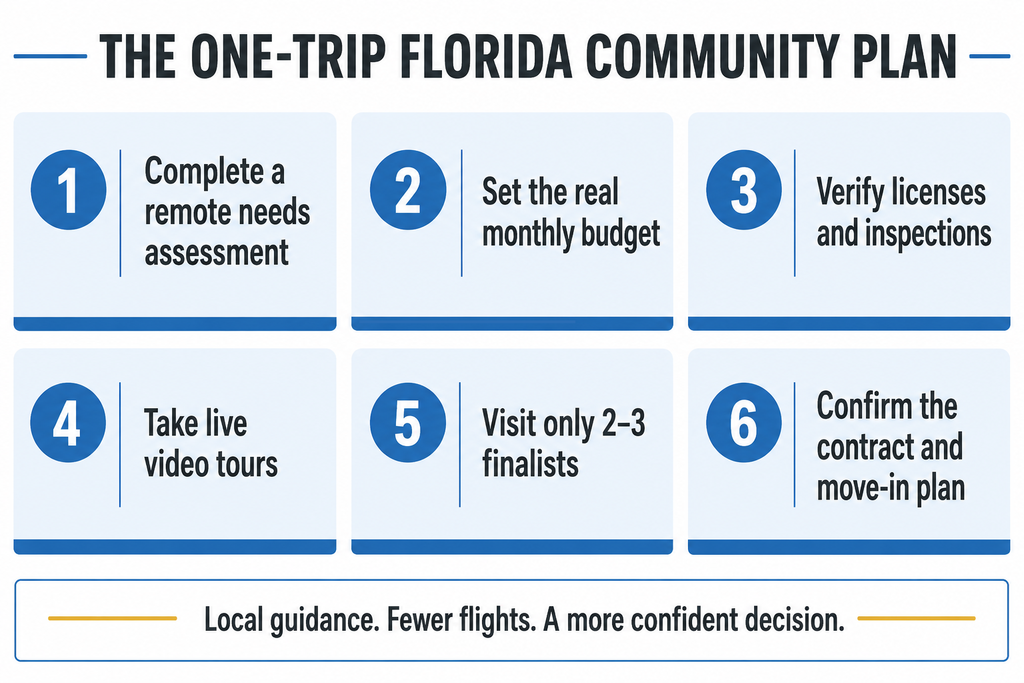
A polished prerecorded tour is useful for orientation, but it should not be the only remote view. Ask for a live video walk-through and have the camera show what you would inspect in person:
Use the same questions for every finalist. Ask who is present overnight, how new residents are welcomed, how care needs are reassessed, what triggers added charges, how rate increases are communicated, what the move-out and refund terms are, and what happens if the community can no longer meet a resident's needs.
Request a written cost breakdown showing the base monthly rate, care-level charges, medication-related fees, recurring fees, and one-time community or move-in fees. This is the only reliable way to compare the expected monthly cost across communities with different pricing structures.
With the assessment, license review, written pricing, and live video tours complete, one carefully planned visit may be enough for the senior and family to compare the strongest choices.
Schedule only two or three finalists and leave time between tours. If possible, visit at least one community during a meal or activity rather than seeing every property at its most staged moment. Pay attention to how staff address residents, whether residents appear engaged, how the building smells, whether call lights or requests are handled promptly, and whether answers remain consistent when you speak with different team members.
Do not sign simply because a promotion expires that day. Review the residency agreement, rate-increase language, care reassessment terms, deposit and refund rules, discharge or transfer provisions, and exactly which services are included. An elder law attorney can review legal language when the agreement or financial commitment warrants it.
For a long-distance family, the job is not finished when the boxes arrive. Decide in advance who will monitor the transition and how information will be shared.
The plan may include:
Elder Care Finders provides a five-day transitional support program after move-in, followed by post-placement communication and monthly family check-ins. That local continuity can be especially valuable when the adult child cannot stop by in person.
Families should also keep contact information for Florida's Long-Term Care Ombudsman Program. The program advocates for residents of assisted living facilities and can help address concerns involving residents' rights or facility care.
Elder Care Finders acts as a knowledgeable local guide for families who cannot personally investigate every South Florida option. We begin with the senior's needs, preferences, location, and budget; recommend appropriate communities; coordinate tours; help compare costs and policies; support the move; and remain involved after placement.
Our advisors help families explore independent living, assisted living, and memory care communities throughout Palm Beach, Martin, and St. Lucie Counties. The senior and family always make the final decision. Our role is to provide local information, structure, and support so that decision can be made with greater confidence.
Placement guidance is available at no cost to families. When a family selects a participating community, that community compensates Elder Care Finders.
You do not have to spend weeks calling communities from another state or fly to Florida without a focused plan. A remote assessment, carefully screened shortlist, live video tours, one organized decision visit, and reliable local follow-up can turn an overwhelming search into a manageable process.
For help finding the right senior living community in Palm Beach, Martin, or St. Lucie County, call Elder Care Finders at (561) 879-8850 or request a free consultation online.
Yes. Elder Care Finders regularly helps adult children and relatives who live elsewhere but need local guidance for a senior in Palm Beach, Martin, or St. Lucie County.
No. A remote needs assessment, written screening, and live video tours can eliminate options that do not fit. When travel and health allow, an in-person visit to the strongest two or three finalists can help the senior and family evaluate comfort, culture, and daily life.
Use FloridaHealthFinder to confirm the facility's license and review specialty licenses, facility details, and available inspection information. Then combine those records with live tours, written pricing, contract review, conversations with staff, and local knowledge.
Elder Care Finders' senior living placement assistance is provided at no cost to families. When a placement is made with a participating senior living community, the community compensates the agency.