A search for senior living can quickly turn into a long list of communities, floor plans, and prices that are difficult to compare. Families may tour a beautiful building, then realize later that it cannot provide the support their loved one needs—or that the full monthly cost is higher than expected.
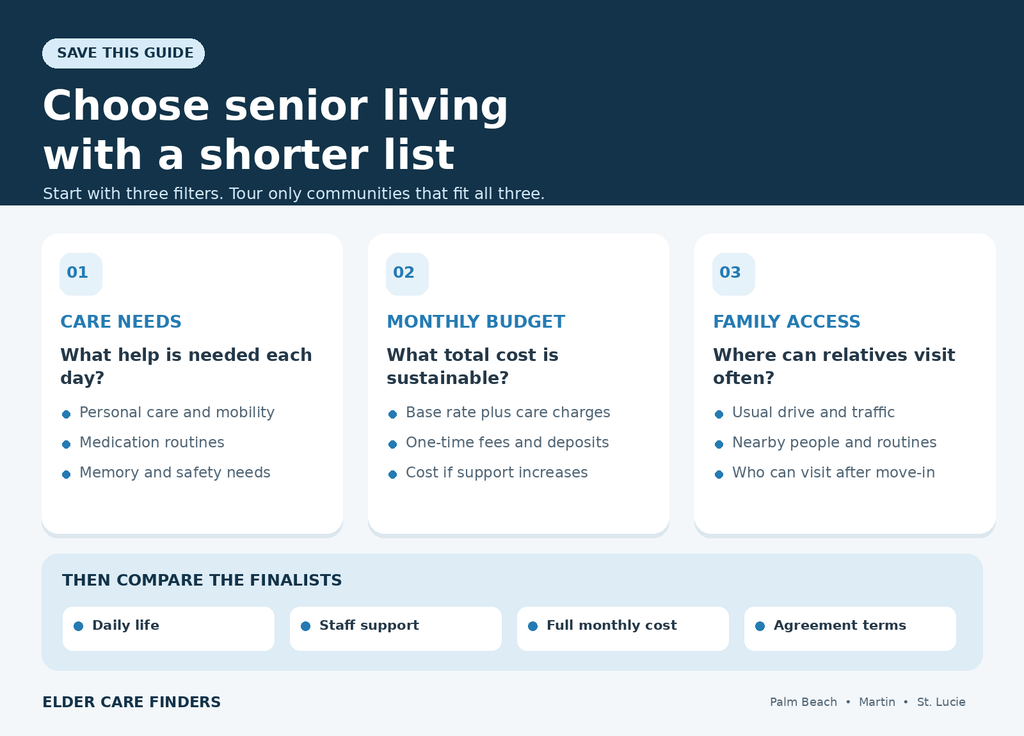
If you’re exploring senior living options in Palm Beach, Martin, and St. Lucie counties, start with three decisions: the level of support needed, a realistic monthly budget, and the places family members can visit regularly. Those answers will give you a useful shortlist before you schedule a tour.
Begin with a typical day, not a community brochure. What does your loved one do comfortably on their own? Where do they need reminders, hands-on help, or someone nearby?
Think through bathing and dressing, meals, medication routines, walking, transportation, and time spent alone. Ask about recent changes, too. A person who managed well six months ago may now need more help—or may simply want company and fewer household responsibilities.
These answers help distinguish among the options Elder Care Finders assists families with:
Independent living may suit an older adult who manages personal care independently but wants a community, activities, meals, or less home upkeep. Ask what services are included and what would happen if daily support becomes necessary later.
Assisted living is worth exploring when someone needs help with daily activities while retaining as much independence as possible. Services and admission criteria vary by community, so describe the help your loved one needs rather than assuming every assisted living community offers the same care.
Memory care may be appropriate when dementia-related changes call for a more structured setting and specialized support. During a tour, ask how staff respond to your loved one’s specific needs, what daily activities look like, and how the community supports safety and dignity.
If the appropriate level of support is unclear, include your loved one’s healthcare professionals in that conversation. You can also speak with Elder Care Finders before choosing which type of community to tour.
A quoted starting rate is only part of the picture. Florida’s Agency for Health Care Administration (AHCA) advises families to review the services and charges in an assisted living agreement before signing.
Ask each community for a written estimate that includes:
Choose a monthly range the family can sustain, then ask what the total might look like if more support is needed. That gives you a more useful comparison than placing three advertised starting prices side by side.
“Close to family” means different things depending on who will visit and how often. Look beyond the county name. Consider the drive from home or work, traffic at the times relatives usually travel, and access to the people and places your loved one values.
A family in Palm Beach County might focus on Jupiter, Palm Beach Gardens, West Palm Beach, or Boca Raton. In Martin County, Stuart, Palm City, or Hobe Sound may make regular visits practical. In St. Lucie County, a family may begin with Port St. Lucie or Fort Pierce. These are starting points, not reasons to rule out a better-fitting community nearby.
If the main decision-makers live outside Florida, decide who can visit locally and how the family will stay involved. Our earlier guide to finding assisted living for a parent in Florida from out of state covers that situation in more detail.
Once you know the care level, budget, and workable locations, build a shortlist of communities that meet all three. A smaller list makes each tour more meaningful.
Ask to see the places residents use every day, including dining and common areas. Find out what an ordinary afternoon looks like. Notice whether staff speak directly with residents, whether activities reflect your loved one’s interests, and whether your loved one seems comfortable asking questions.
For assisted living communities, use FloridaHealthFinder’s facility tools to check licensing and review available facility information. AHCA recommends visiting more than one community and speaking with staff and residents as part of the decision. A tour and a facility record each tell you something different; use both. Source: AHCA’s Assisted Living in Florida guide.
Keep the same notes for every community so the details do not blur together:
The strongest choice is the community that fits the person and the family’s circumstances—not necessarily the one with the longest amenity list.
Elder Care Finders helps families compare independent living, assisted living, and memory care communities in Palm Beach, Martin, and St. Lucie counties. We can help you clarify priorities, develop a shortlist, arrange tours, and compare the details afterward. Our senior living placement guidance is provided at no cost to families.
If you’re unsure where to begin, call (561) 879-8850 for a conversation about your loved one’s needs. You can also explore our long-term care planning and consulting service if your family is planning ahead.
The material contained on this site is for informational purposes only and DOES NOT CONSTITUTE THE PROVIDING OF MEDICAL ADVICE, and is not intended to be a substitute for independent professional medical judgment, advice, diagnosis, or treatment. Always seek the advice of your physician or other qualified healthcare providers with any questions or concerns you may have regarding your health.