Published by Elder Care Finders | Memory Care
There is no guidebook for this moment. No class you took, no conversation you had that fully prepared you for the day you realized your loved one needed more care than you could give at home — care specifically designed for someone whose memory is slipping away in ways that are frightening, unpredictable, and deeply personal.
For families in Palm Beach County, Martin County, and St. Lucie County navigating this decision, the search for a memory care community is one of the most consequential processes they will ever undertake. The communities that specialize in Alzheimer's disease and dementia are not simply assisted living facilities with a different name. They are specialized environments built from the ground up to address the unique and evolving needs of people whose cognitive function is compromised — and the differences between a well-chosen community and a poorly chosen one can have a profound impact on your loved one's safety, dignity, and quality of life.
This guide is designed to help you understand what you are actually evaluating when you walk through the doors of a memory care community — and what questions, observations, and considerations should shape your decision.
Before evaluating specific communities, it helps to understand what separates memory care placement from other forms of senior living. Many families begin this process believing that a high-quality assisted living facility will serve their loved one just as well. In some early-stage cases, that may be true. But as Alzheimer's disease and other forms of dementia progress, the gap between standard assisted living and true memory care becomes significant.
Memory care communities are purpose-built for residents with cognitive impairments. The physical environment is intentionally designed to reduce confusion and prevent wandering — one of the most dangerous behaviors associated with dementia. Layouts are typically circular or looping rather than linear, so residents can walk freely without reaching a dead end that triggers distress. Secure entrances, alarmed doors, enclosed outdoor spaces, and visual cues embedded throughout the community all serve to create safety within a sense of freedom.
The staffing model is fundamentally different as well. Memory care staff receive specialized training in dementia care techniques that go well beyond what is required in general assisted living. They learn how to communicate with someone who can no longer process language the way they once did. They learn how to de-escalate sundowning episodes — the late-afternoon and evening agitation that many people with dementia experience. They learn how to redirect rather than correct, how to respond to behaviors rather than diagnose them, and how to deliver care in a way that preserves dignity even when a person cannot clearly express their own wishes.
Programming in memory care communities is also purpose-designed. Activities are chosen for their ability to engage residents at the cognitive level they are currently at, not the level they were once at. Music therapy, reminiscence programs, sensory stimulation, simple craft activities, and movement programs all play a role in maintaining quality of life for people whose connection to the world has changed.
Understanding these distinctions is the foundation for evaluating any specific community — because you are not comparing hotel amenities. You are evaluating a clinical and social environment that will shape every day of your loved one's life.
Walk-through visits to memory care communities are not just information-gathering exercises. They are opportunities to observe what a community actually looks and feels like when it is operating — not what it looks like in a brochure or on a website.
Before you speak to a sales coordinator, before you sit down in a conference room with printed materials, pay attention to what your senses tell you.
The atmosphere when you arrive. Does the unit feel calm, or does it feel chaotic? Is the noise level appropriate, or is there an undercurrent of distress — residents calling out repeatedly, staff speaking sharply, alarms sounding without immediate response? A well-run memory care unit has a particular quality of calm that is actively maintained by the staff. It is not silence — it is managed, purposeful engagement.
How staff interact with residents. Watch the interactions you are not meant to notice — the aide passing a resident in the hallway, the staff member at the nurses' station, the activity coordinator setting up a program. Are they warm? Are they patient? Do they make eye contact, speak at eye level, use the resident's name? The small, unrehearsed interactions reveal far more about culture than any prepared tour.
The physical environment. Is the space clean, well-maintained, and odor-free? Are there personal touches in resident rooms and common areas that signal individuality is valued? Is natural light present? Are there safe outdoor spaces that residents can access? Is wayfinding — the system of visual cues that helps people with dementia navigate the space — clearly implemented throughout the community?
Resident engagement. Are residents sitting alone staring at blank walls, or are they engaged in activities, social interaction, or meaningful occupation? A community where residents appear disengaged or sedated — even during visiting hours — is telling you something important about its day-to-day programming and its philosophy of care.
None of these observations require you to be a healthcare professional. They require you to trust what you are seeing and feeling — and to recognize when something does not sit right.
If there is a single factor that has the greatest influence on the quality of a memory care community, it is staffing — specifically, who the staff are, how they are trained, how many of them are present at any given time, and how long they stay.
Memory care communities should maintain lower staff-to-resident ratios than general assisted living — particularly during the evening and overnight hours when the risk of wandering, falls, and sundowning episodes is highest. Ask specifically about ratios during every shift, not just daytime hours. A community that maintains excellent ratios from 9 AM to 5 PM but reduces to minimal staffing overnight is not providing the level of coverage its marketing materials may imply.
Ask what specific dementia-care training staff receive before working with residents, and what ongoing training the community provides. The best communities invest continuously in their staff's knowledge — not because regulations require it, but because they understand that dementia care is a clinical discipline that evolves. Look for references to specific training methodologies, and ask whether the community has a Director of Memory Care or a clinical consultant with specialized expertise.
High staff turnover is one of the most underappreciated warning signs in senior living. For people with dementia — who depend heavily on routine, familiar faces, and consistent interaction patterns — frequent staff changes are genuinely disruptive to wellbeing. Ask how long the current staff have been with the community, what the turnover rate is, and whether the same caregivers are consistently assigned to the same residents. A community that cannot answer these questions, or deflects them, is not a community you want for your loved one.
Every resident in a memory care community should have an individualized care plan — a living document that reflects their current needs, preferences, history, and goals, and that is regularly updated as their condition evolves. The care plan process is one of the clearest indicators of whether a community provides genuinely person-centered care or merely standardized service delivery.
Ask how care plans are developed. Who participates — is the family included? Is the resident's own voice captured to whatever extent possible? How often are care plans reviewed and updated? What happens when a resident's needs change significantly — is the family immediately notified, and is the care plan adjusted in real time?
The best memory care communities treat the care plan not as a compliance document but as the central organizing framework of everything they do for a resident. Staff should be familiar with what is in each resident's care plan — not just reading it at the start of a shift, but genuinely knowing the person and what matters to them.
This is also the moment to discuss levels of care and how the community manages progression. Alzheimer's disease and other forms of dementia are progressive conditions, meaning care needs will increase over time. Ask what happens when a resident's needs exceed the community's current care capabilities. Does the community have a mechanism for increasing care intensity? Or does advancing disease mean a move to a different facility? Understanding this at the outset prevents an emotionally devastating forced transition later.
For families navigating these questions with guidance, long-term care planning and consulting is one of the most valuable resources available — helping families think through not just the immediate placement decision but the full arc of a loved one's care needs.
Ask for a detailed description of a typical weekday and a typical weekend day. The answer tells you a great deal. Communities with robust, intentional programming will describe their day with specificity — the morning movement class, the reminiscence group before lunch, the music therapy session in the afternoon, the evening wind-down activities. Communities where programming is an afterthought will give you vague answers about "activities" without substance.
For people with dementia, meaningful daily engagement is not a luxury — it is a clinical intervention. Evidence strongly supports the role of purposeful activity in slowing cognitive decline, reducing agitation, improving mood, and maintaining physical function. A memory care community that treats programming as a checkbox is missing one of its most powerful tools.
Ask specifically about:
Music therapy. The neurological connection between music and memory is one of the most well-documented phenomena in dementia care. Even in late-stage Alzheimer's, people who can no longer recognize family members often respond with recognition and emotion to music from their past. A community that does not incorporate music therapy in some intentional way is missing a significant opportunity.
Outdoor access. Time outdoors — natural light, fresh air, gentle movement — has measurable benefits for people with dementia. Ask whether residents have regular, safe access to enclosed outdoor spaces and how staff facilitate that access throughout the day.
Family inclusion. How does the community involve families in programming and daily life? Are family members encouraged to participate in activities? Is there clear communication about what your loved one did that day, how they ate, how they slept, and how their mood was? Regular, substantive communication between the community and family members is a hallmark of excellent care.
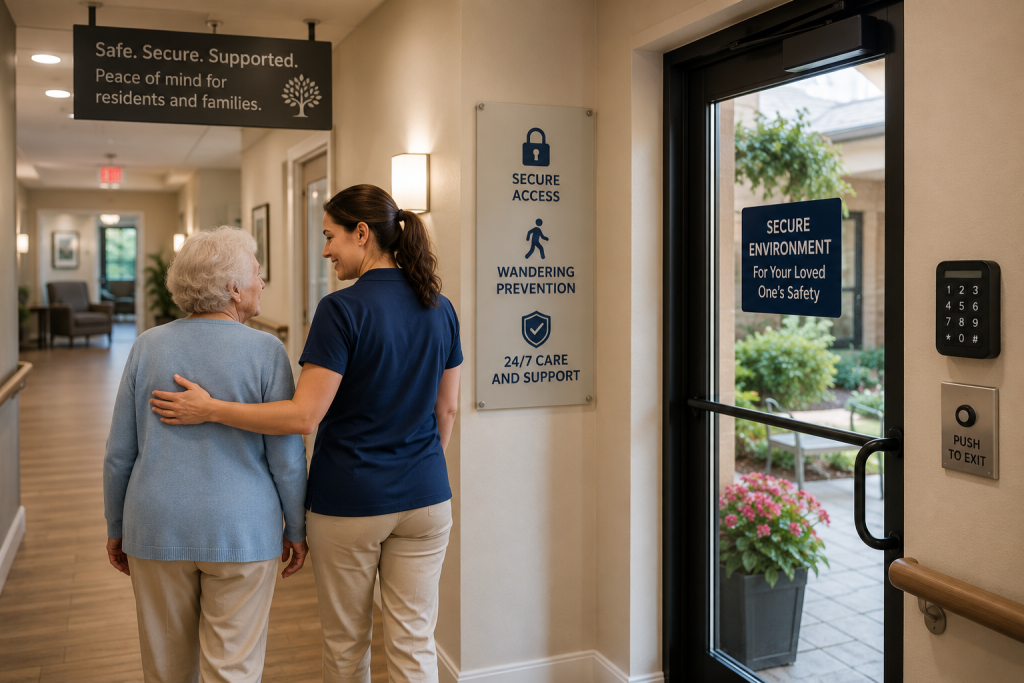
Wandering is one of the most significant safety risks for people with Alzheimer's disease and other forms of dementia. It is not a behavior born of stubbornness or confusion about rules — it is a neurological symptom driven by the disease itself, and a well-designed memory care community addresses it through both environmental design and operational protocol.
Ask about the community's specific anti-wandering measures. What kind of door security systems are in use? How are exits monitored? Is there a secured outdoor space where residents can walk freely without risk of leaving the property? What happens if a resident does successfully exit the unit — what is the protocol, and what is the response time?
Also ask about fall prevention. People with dementia are at elevated risk for falls — both because of the neurological effects of the disease and because of the medications commonly used to manage behavioral symptoms. What does the community do proactively to reduce fall risk? How are falls documented and analyzed? What changes are made after a fall occurs?
These are not questions to ask apologetically. They are the questions that any well-run memory care community should expect and welcome — because they demonstrate that you are a family that will be engaged and attentive, which is exactly what good communities want.
Nutrition is a genuine challenge in memory care. People with dementia often forget to eat, lose the ability to use utensils, develop food preferences that shift dramatically from their prior tastes, or become unable to recognize hunger and thirst signals. A memory care community that takes dining seriously — that designs its dining program with these challenges explicitly in mind — is investing in the health and wellbeing of its residents at a fundamental level.
Ask what the dining experience looks like. Are residents assisted with meals in a way that is respectful and patient? Are there options for residents who cannot manage a full plate — finger foods, small frequent snacks, modified textures for those with swallowing difficulties? Is hydration actively encouraged throughout the day, not just at mealtimes?
The dining room itself is worth observing. Is it calm, with soft lighting and manageable noise levels? Or is it loud, chaotic, and visually overwhelming — an environment that triggers agitation rather than appetites? The sensory environment of a memory care community matters far more than most families realize, because people with dementia process sensory input differently and are often acutely sensitive to overstimulation.
Memory care is a significant financial commitment, and the cost structures can be complex. Most communities charge a base monthly rate that covers a defined level of care, with additional fees for higher care needs, specialty services, incontinence supplies, medication management, and other items that may not be obvious at first. Understanding exactly what is and is not included in the base rate — before you sign anything — is essential.
Ask for a complete, itemized breakdown of all potential charges. Ask what triggers a care level increase and how much notice families receive before costs change. Ask about the community's policy if a resident's financial resources are exhausted — particularly whether they accept Medicaid or have other financial assistance mechanisms.
For families who are uncertain how to navigate these financial conversations, senior living placement services through Elder Care Finders include guidance on costs, contracts, and financial planning considerations — at no cost to the family. Our placement coordinators have toured these communities, reviewed their cost structures, and can help families compare what they are actually getting for what they are paying.
Families who attempt to evaluate memory care communities entirely on their own face a significant disadvantage: they do not know what they do not know. The questions in this guide give you a framework, but a placement specialist who has toured dozens of communities in Palm Beach County, Martin County, and St. Lucie County brings something different — direct, current, firsthand knowledge of which communities live up to their reputation and which ones fall short.
Senior placement services through Elder Care Finders are provided at no cost to families. Our specialists begin with a comprehensive needs assessment — understanding your loved one's current stage of dementia, their behavioral profile, their social and personal history, their medical needs, and the family's geographic and financial parameters. We then identify the communities that are genuinely the best fit, accompany families on tours, help them ask the right questions, and remain involved through move-in coordination and beyond.
For families who have already toured communities and feel overwhelmed by the options, we can help make sense of what you saw and guide you toward a clear decision. For families who are just beginning the process, we can save weeks of research and several stressful tours by pointing you directly toward the communities that are most likely to be right.
The assisted living placement and memory care placement services we offer are built on over 20 years of experience in South Florida senior care. Our team knows the communities, knows the staff, and knows what families actually encounter after move-in — not just what the tour suggests.
One of the most common regrets families express is waiting too long. By the time a crisis forces a rapid placement decision — a fall, a hospital stay, a behavioral incident that the family can no longer manage — the window for careful, deliberate evaluation has often closed. Decisions made in crisis are rarely optimal decisions.
The right time to start evaluating memory care communities is before the immediate need is obvious. If your loved one has been diagnosed with Alzheimer's disease or another form of dementia, the conversation about future care options — including memory care — should begin now. Visiting communities while your loved one can still participate in the process, while they can still express preferences and respond to environments, produces better outcomes than waiting until they cannot.
It also gives you time. Time to visit multiple communities, ask follow-up questions, review contracts carefully, and make a decision based on careful thought rather than urgency. A placement specialist from Elder Care Finders can help you structure this process — giving it shape, a timeline, and a clear path forward.
Elder Care Finders serves families throughout Palm Beach County, Palm Beach Gardens, Boca Raton, Delray Beach, Boynton Beach, Jupiter, Tequesta, Stuart, and Saint Lucie County.
We understand that evaluating memory care communities is one of the most emotionally and logistically demanding things a family can do — and we are here to make it easier. Our placement coordinators provide personalized guidance, honest assessments, and consistent support from the first conversation through move-in and beyond.
If you are beginning this process or feeling overwhelmed by it, we encourage you to reach out. A brief conversation with our team can bring clarity to a process that may feel impossibly complex right now.
Contact Elder Care Finders today to request a free consultation — call us at 561-879-8850 or fill out our contact form and a placement coordinator will be in touch promptly.
What is the difference between memory care and assisted living? Memory care is a specialized form of senior residential care designed specifically for people with Alzheimer's disease or other forms of dementia. It differs from standard assisted living in its physical environment, staffing training, programming, and security measures. While some assisted living communities offer a memory care wing or unit, purpose-built memory care communities typically provide the most comprehensive and consistent level of support.
How do I know when it is time to move a loved one to memory care? Common indicators include wandering or elopement attempts, behavioral changes that are difficult to manage at home, significant decline in the ability to perform daily activities, caregiver burnout, and safety concerns that cannot be addressed in the current living situation. A placement specialist can help families assess where their loved one is and what level of care is most appropriate.
How much does memory care cost in Palm Beach County? Costs vary significantly depending on the community, its location, and the level of care required. Families should expect to review itemized cost breakdowns carefully and ask about what is included in the base rate versus charged separately. Elder Care Finders can help families understand the cost landscape and compare options within their budget.
Does Elder Care Finders charge a fee for memory care placement services? No. Our placement services are provided at no cost to families. We are compensated by the senior living communities we work with, which means families receive expert, personalized guidance without any out-of-pocket expense for our services.
Can I tour memory care communities before my loved one needs to move? Yes — and we strongly encourage it. Visiting communities in advance, while you have time to be deliberate, leads to far better placement decisions than searching under the pressure of an immediate need. Our team can identify the best options and accompany you on tours whenever you are ready to begin.
What happens after my loved one moves into a memory care community? Elder Care Finders provides a 5-day transitional support program upon move-in and a post-placement support program that includes monthly check-ins and ongoing communication with the family. We remain a resource for families as their loved one's needs evolve.
The material contained on this site is for informational purposes only and DOES NOT CONSTITUTE THE PROVIDING OF MEDICAL ADVICE, and is not intended to be a substitute for independent professional medical judgment, advice, diagnosis, or treatment. Always seek the advice of your physician or other qualified healthcare providers with any questions or concerns you may have regarding your health.