Most families don’t arrive at the decision to explore assisted living because of one dramatic moment. They arrive after months of small worries that quietly stacked up — a bruise that wasn’t explained, a missed doctor’s appointment, a phone call that felt a little off. By the time the conversation becomes unavoidable, families often wish they had started it sooner.
Knowing when is it time for assisted living is rarely obvious in the moment. The signs tend to be gradual, easy to rationalize, and easy to miss when you’re seeing your loved one every day. This guide covers eight of the most commonly overlooked signals — and what to do when you start recognizing them.
A fall that results in an injury is hard to ignore. But near-falls — the moments where a senior catches themselves on a countertop, stumbles getting out of a chair, or grabs a wall for balance — often get dismissed as minor. Families hear “I’m fine, it was nothing” and move on.
Near-falls matter as much as actual falls, and in some cases more, because they reveal a pattern before a serious injury occurs. When balance and mobility are declining, the home environment that felt safe for decades can quietly become the most dangerous place a senior spends time. Uneven rugs, bathtubs without grab bars, and steps that were never a problem become genuine hazards — and no amount of rearranging furniture fully addresses a body that is losing stability.
Assisted living communities are designed from the ground up with this in mind: wide hallways, grab bars in every bathroom, non-slip flooring, and staff available around the clock for transfers and mobility support.
Managing multiple medications correctly is genuinely hard, even for people in good cognitive health. The combination of multiple prescriptions, varying schedules, refill timing, and drug interactions creates a system that is surprisingly easy to get wrong. When a senior is managing this alone — or with family checking in only occasionally — missed doses, doubled doses, and expired medications are common.
Watch for pill organizers that aren’t being used correctly, bottles with far more or far fewer pills than expected, or a loved one who can’t clearly describe what they take and when. These aren’t signs of carelessness — they’re signs that the cognitive or organizational load has become too much to manage independently.
In an assisted living setting, medication management is handled by trained staff as part of the daily routine, removing one of the most consequential risks of living alone.
Significant, unintentional weight loss in an older adult is rarely just about appetite. It often signals a combination of factors: difficulty preparing meals, forgetting to eat, loss of motivation to cook for one, dental pain that makes eating uncomfortable, or early cognitive changes that disrupt eating routines.
A refrigerator full of expired food, a freezer stocked with untouched meals, or a loved one who has lost ten or more pounds over a few months without a medical explanation all warrant attention. Weight loss at this level affects immunity, energy, wound healing, and cognitive function — and it tends to accelerate other health problems rather than resolve on its own.
Assisted living communities provide three structured meals daily plus snacks, prepared by kitchen staff with nutrition in mind. The social environment of dining with others also dramatically improves how much seniors actually eat compared to eating alone at home.
Loneliness in older adults carries real health consequences that are well-documented: increased risk of cognitive decline, depression, weakened immune function, and shorter life expectancy. It is not simply a matter of being sad. It is a medical concern that is often hidden behind a senior’s insistence that they are doing fine.
When a parent who used to be social stops calling friends, declines invitations, lets memberships lapse, or seems flat and disengaged during visits, isolation is likely already setting in. This tends to worsen over time as driving becomes limited, mobility decreases, and the social world gradually contracts.
The structured social calendar of an assisted living community — daily activities, shared meals, group outings, and a built-in community of peers — addresses isolation in ways that family visits on weekends simply cannot replicate.
A home that was always kept clean and organized doesn’t become cluttered or dirty overnight — it happens gradually, which is exactly why families often don’t notice how much things have changed until a visit after a few months apart.
Look beyond the obvious. Dishes piling up is visible. But also pay attention to mail that hasn’t been opened for weeks, laundry that isn’t getting done, a yard that’s been neglected, or small household repairs that have been ignored. These are not laziness — they are signs that the energy and cognitive bandwidth required to maintain a home are exceeding what a senior can reliably provide.
This sign is especially significant when combined with others on this list, because home upkeep is often one of the last things people let go before they acknowledge that daily life has become genuinely unmanageable on their own.
Families often frame the assisted living conversation entirely around their loved one’s needs — which makes sense — but caregiver burnout is a legitimate and important signal in its own right. When an adult child or spouse is providing significant daily care, the physical and emotional toll accumulates in ways that affect their health, their relationships, their work, and their ability to continue providing care at all.
Caregiver burnout often looks like chronic exhaustion, resentment that feels unfamiliar and uncomfortable, anxiety about every phone call, and a loss of the ability to simply be a daughter, son, or spouse rather than a full-time caregiver. If you recognize yourself in this description, it is not a sign of weakness — it is a sign that the care needs have exceeded what one person or one family can reasonably provide.
Transitioning a loved one to assisted living is not abandonment. For most families it becomes the thing that allows them to be present as family again, rather than burned-out caregivers.
A senior who wanders from home, gets lost driving a familiar route, or becomes confused about where they are in a place they have been many times before is showing signs of cognitive decline that require immediate attention. This is one of the clearest signals that living alone is no longer safe.
Wandering is strongly associated with Alzheimer’s disease and other forms of dementia, and it carries serious risks: falls, exposure to weather, traffic accidents, and the acute distress of a senior who doesn’t understand why they are lost or frightened. If this has happened even once, the conversation about care level needs to happen now, not later.
For seniors showing these signs, memory care within a secure assisted living environment provides the specialized supervision, structured environment, and trained staff that can keep them safe while preserving dignity and quality of life.
Beyond falls, there are safety incidents that don’t always make it into family conversations: a stove left on, a door left unlocked overnight, a car accident in a parking lot, a burn from a pan that was forgotten. Any one of these, taken alone, might seem like a minor lapse. Together, or in a pattern, they indicate that independent living is creating genuine risk.
This is often the sign families find hardest to bring up because it requires acknowledging that a loved one is no longer as capable as they were — a conversation that can feel like a threat to someone’s identity and autonomy. But the goal is never to take something away. It is to find an environment where safety is built in and daily life doesn’t require the kind of constant vigilance that is no longer sustainable at home.
Recognizing the signs is one thing. Knowing what to do with that recognition is another. Most families describe the period between “we think something needs to change” and “we know what to do” as one of the most overwhelming parts of the entire process.
A few things help:
Start the conversation before a crisis forces it. Decisions made under pressure — after a hospitalization, after a fall with serious injury, after a wandering incident — are harder on everyone, including your loved one. Having the conversation while there is still time to research, visit communities, and make a thoughtful choice leads to better outcomes and a less traumatic transition.
Let your loved one be part of the process. When seniors feel that assisted living is happening to them rather than with them, resistance is far more likely. When they are involved in touring communities and making choices, they are more likely to engage positively with the transition.
Understand that the right community makes a real difference. Not all assisted living facilities are the same. The right match — in terms of care level, culture, location, and budget — matters enormously for how well a senior adjusts and thrives. This is exactly where professional placement guidance earns its value.
Elder Care Finders provides assisted living placement services that are completely free to families. Our fees are paid by the communities we work with, which means families get expert, personalized guidance at no cost to them.
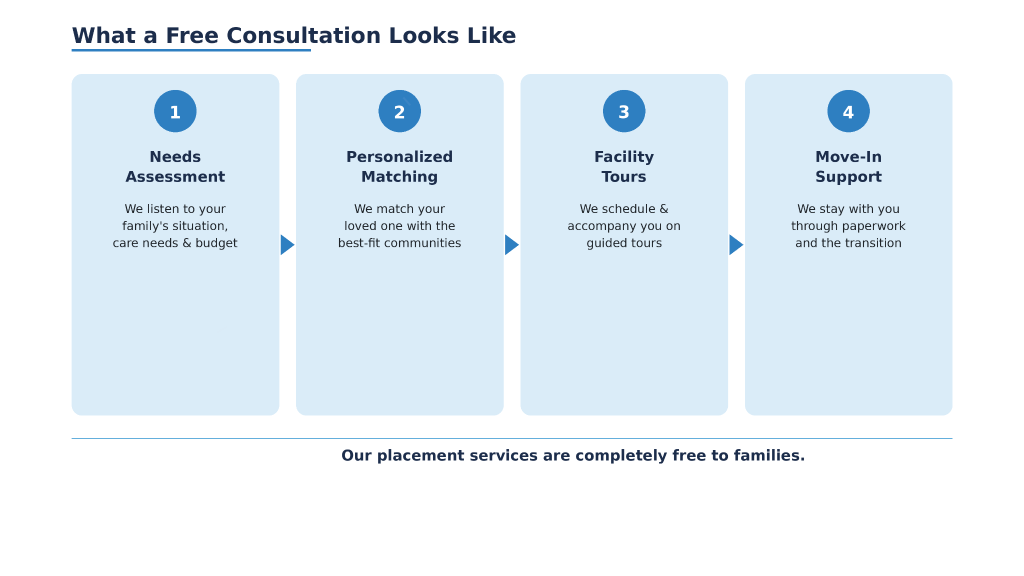
When you reach out, here is what happens:
We begin with a needs assessment — a real conversation about your loved one’s current situation, health needs, daily support requirements, budget, and preferred location. We listen first and advise second, because a placement is only as good as the understanding behind it.
From there, we develop a personalized shortlist of communities that fit the care level, lifestyle preferences, and financial parameters you’ve shared. We draw on deep local knowledge of communities across Palm Beach and Broward Counties, including options that families rarely find on their own through general internet searches.
We then coordinate and accompany you on tours — guiding what to look for, what to ask, and how to compare what you are seeing honestly. Touring assisted living communities without guidance can feel overwhelming. Touring with someone who knows these facilities and has placed families in them changes the experience entirely.
Once a decision is made, we stay involved through paperwork, logistics, and move-in coordination. And our move-in support program continues for the first five days after transition, with a monthly follow-up program to make sure your loved one is settling in well.
If you have been noticing any of the signs described in this article — or if you simply have a feeling that something has shifted and you are not sure what to do about it — a conversation costs nothing and can bring a great deal of clarity. Reach out to our team at Elder Care Finders and let us help your family find the path forward. You do not have to figure this out alone.
The material contained on this site is for informational purposes only and DOES NOT CONSTITUTE THE PROVIDING OF MEDICAL ADVICE, and is not intended to be a substitute for independent professional medical judgment, advice, diagnosis, or treatment. Always seek the advice of your physician or other qualified healthcare providers with any questions or concerns you may have regarding your health.