What experienced advisors notice before the polished tour has time to take over
A senior community tour is designed to show you the building at its best. The lobby is polished, the model apartment is ready, and the schedule often moves you past the strongest selling points in a careful order. None of that is automatically a problem. A good community should be proud of what it offers.
The more revealing information is usually happening just outside the tour script. Experienced advisors watch how staff members speak to residents, whether common areas feel genuinely active, how clearly pricing questions are answered, and what happens when the conversation turns to staffing or future care needs. These assisted living red flags do not always mean a community is unsafe. They mean you should slow down, ask better questions, and avoid making a decision based on appearance alone.
At Elder Care Finders, we have spent more than 17 years helping families compare senior living options across Palm Beach, Martin, and St. Lucie Counties. Here is what we notice first.
Before the formal tour begins, pause. Notice the entrance, reception desk, nearby hallway, and first common area. That short window often shows you the everyday culture before anyone has had time to redirect your attention.
Do staff members greet residents by name? Are residents talking, moving through the building, or participating in something meaningful? Does the person leading your tour answer direct questions directly? The goal is not to catch a community making a mistake. It is to see whether the lived experience matches the sales presentation.
1. A Strong Masking Scent - or an Odor No One Addresses
Every senior community will occasionally have an accident, a housekeeping issue, or a temporary odor. One imperfect moment is not proof of poor care. What deserves attention is a powerful air freshener throughout the building, a persistent urine or mildew smell, or a staff member who dismisses a reasonable question about cleanliness.
Ask how often resident rooms and shared spaces are cleaned, how incontinence care is handled, and what the response process is when a spill or accident occurs. A strong operator should be able to explain the system without becoming defensive.
2. Staff Body Language That Changes Around Residents
Watch the interactions that are not performed for you. Do caregivers make eye contact and wait for residents to finish speaking? Do they knock before entering rooms? Does a resident asking for help receive acknowledgment, even if the staff member cannot respond immediately?
A beautiful building cannot compensate for a culture where residents are spoken over, ignored, or treated like tasks. Warmth is not a bonus amenity. It is part of daily quality of life.
3. Residents Are Present, but Not Engaged
A full common room can look active from the doorway. Look closer. Are residents participating, conversing, or choosing to relax? Or are several people parked in front of a television with little interaction for long stretches?
Quiet time is normal, and not every resident wants constant activity. The red flag is a repeated pattern of passivity with no visible staff engagement, no choices being offered, and no evidence that programming is adapted to different abilities. Ask to see last month's actual activity calendar, then ask which events took place and how participation is encouraged.
4. Pricing Answers Stay Vague
The monthly base rate is only one part of the cost. Families also need to understand care-level fees, medication management, incontinence support, transportation, community fees, deposits, annual increases, and what happens when needs change.
Be cautious when every answer ends with 'it depends' but no written range, fee schedule, or assessment process is provided. Ask for a sample agreement and a current, itemized pricing sheet before you become emotionally committed to a particular apartment.
5. Turnover Questions Create Discomfort
Turnover happens in every industry, including senior living. The concern is not that someone left. It is that leadership changes constantly, caregiver assignments are unstable, or the community will not discuss average tenure and open positions.
Ask how long the executive director, wellness director, and memory care director have been in their roles. Ask whether agency staff are regularly used and how new employees are trained. Consistency matters because residents depend on staff members knowing their routines, preferences, and changes in condition.
6. You Feel Pressure to Sign Today
Limited availability can be real. Pressure tactics are different. Statements such as 'this rate disappears tonight' or 'another family is about to take it' should never replace the time you need to review pricing, care capabilities, inspection history, and contract terms.
A community that is truly appropriate should withstand thoughtful questions. If urgency is genuine, ask for the deadline and terms in writing. Never let a deposit become a substitute for due diligence.
7. The Tour Is Too Controlled
Notice what you are not allowed to see. Are you discouraged from viewing the dining room during a meal, walking through a resident hallway, meeting the wellness director, or returning at a different time? Some areas require privacy and safety limits, but reasonable requests should receive reasonable explanations.
Whenever possible, visit more than once. A weekday morning, late afternoon, or weekend can reveal different staffing patterns and a more complete picture of community life.
8. The Community Cannot Clearly Explain Its Care Limits
A community may be excellent and still be the wrong match for your parent. Ask what needs it can support today, what changes trigger a higher care level, and what conditions could require a move. This is especially important when comparing assisted living with specialized memory care.
If cognitive changes are part of the decision, review the differences between assisted living and memory care and ask how staffing, training, security, and programming change between settings.
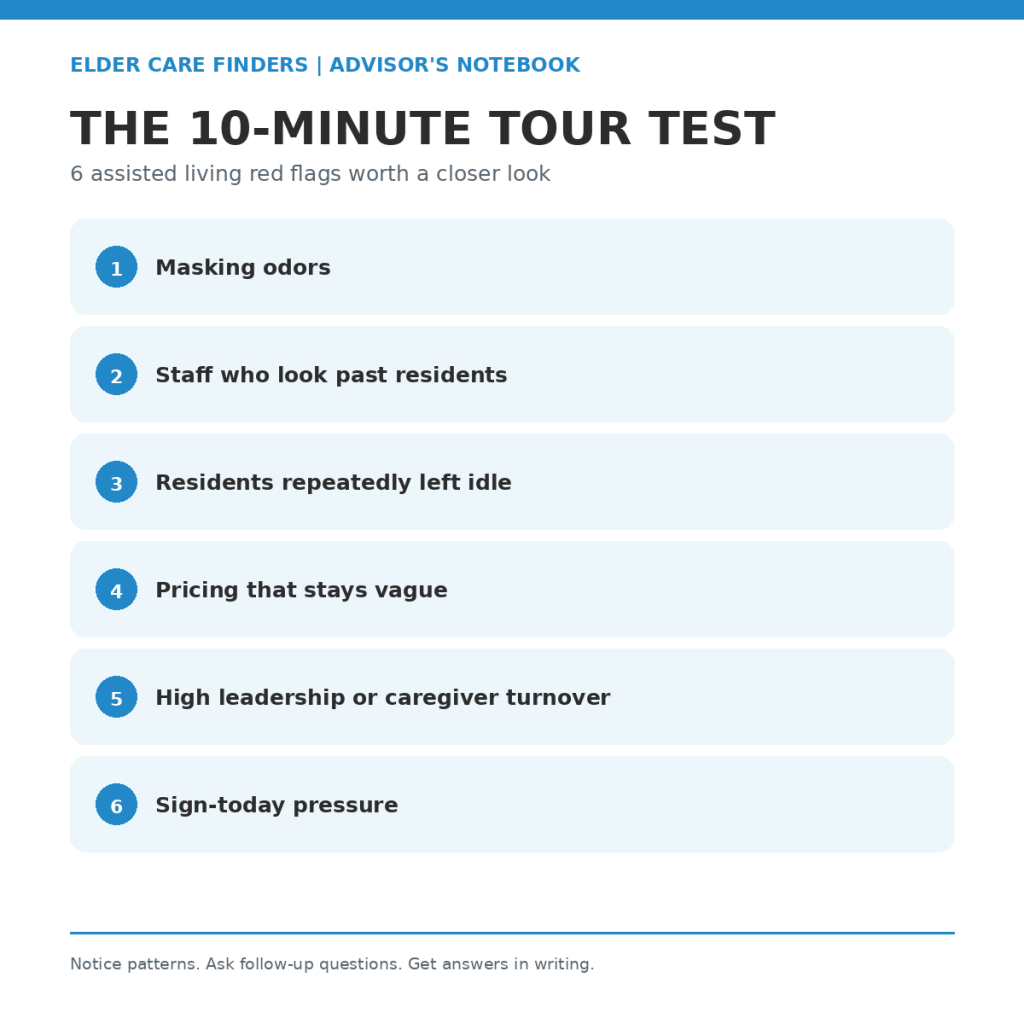
The 10-minute tour test: six signs that deserve follow-up questions.
Use what you notice to ask specific follow-up questions:
Question 1: How many direct-care staff members are scheduled on this floor during the day, evening, and overnight?
Question 2: How long have the executive director and wellness director been here?
Question 3: Which services are included in the quoted monthly rate, and what can increase it?
Question 4: May I review the residency agreement and fee schedule before paying a deposit?
Question 5: What changes in health, mobility, or cognition could require a transfer or move-out?
Question 6: May we return for a second visit at a different time or share a meal?
A tour is one piece of the decision. In Florida, use FloridaHealthFinder to confirm the facility's license, specialty licenses, administrator and ownership information, inspection reports, emergency actions, and other available records. Read the most recent reports, but also look for patterns and whether issues were corrected.
Families can also contact Florida's Long-Term Care Ombudsman Program for free, confidential information or help with concerns involving a resident's quality of life, care, safety, or rights. Florida assisted living residents have rights that include a safe and decent living environment, respectful treatment, privacy, and opportunities for independence and community participation.
Do not panic, and do not explain it away. Write down what you observed, ask a direct question, and note whether the answer is specific, respectful, and supported in writing. One isolated concern may have a reasonable explanation. Several concerns pointing in the same direction are more meaningful.
Compare communities using the same questions. That keeps an impressive lobby, a friendly salesperson, or a temporary discount from carrying more weight than staffing stability, resident dignity, care capability, and total cost.
Elder Care Finders provides senior living placement services for families across Palm Beach, Martin, and St. Lucie Counties. We assess needs, create a targeted shortlist, coordinate tours, help families compare pricing and care levels, and remain involved through move-in and follow-up.
Whether your family is exploring assisted living placement, memory care placement, or long-term care planning, our guidance is always free to families because participating communities compensate us - never the family.
Ready to tour with more confidence? Call Elder Care Finders at 561-879-8850 or schedule a free consultation.
No. Temporary odors can occur in any community. Pay attention to persistent smells, heavy masking fragrances, visible cleanliness issues, and whether staff explain their response process clearly.
Yes, when time allows. A second visit at a different time or on a weekend can help you compare staffing, dining, activities, and the overall pace of the community.
Ask for an itemized fee schedule, sample residency agreement, deposit and refund terms, care-level assessment details, rate-increase language, and a written estimate based on your loved one's current needs.
Search the community through FloridaHealthFinder. Review its license information, specialty licenses, inspection reports, emergency actions, and available ownership or administrator details.
Yes. Elder Care Finders coordinates and accompanies families on tours, helps interpret what they see and hear, and compares the options against care needs, lifestyle, location, and budget. The service is free to families.
FloridaHealthFinder Assisted Living Consumer Guide: Verify licensure, specialty licenses, inspection reports, emergency actions, and facility details.
Florida Long-Term Care Ombudsman Program: Free, confidential advocacy and complaint support for residents and families.
The material contained on this site is for informational purposes only and DOES NOT CONSTITUTE THE PROVIDING OF MEDICAL ADVICE, and is not intended to be a substitute for independent professional medical judgment, advice, diagnosis, or treatment. Always seek the advice of your physician or other qualified healthcare providers with any questions or concerns you may have regarding your health.