Published by Elder Care Finders | Senior Living Placement — Free to Families
Every assisted living tour follows a script — and because our senior placement services are free to families, we've walked hundreds of these tours alongside the families we serve, so we know that script by heart. You'll see the model apartment, the bright dining room at its calmest hour, the activity calendar posted in the hallway, and the friendliest staff member in the building. None of it is dishonest. But the tour is designed to answer the questions communities want you to ask — and the decisions that actually determine whether your parent thrives there hinge on the questions they don't volunteer.
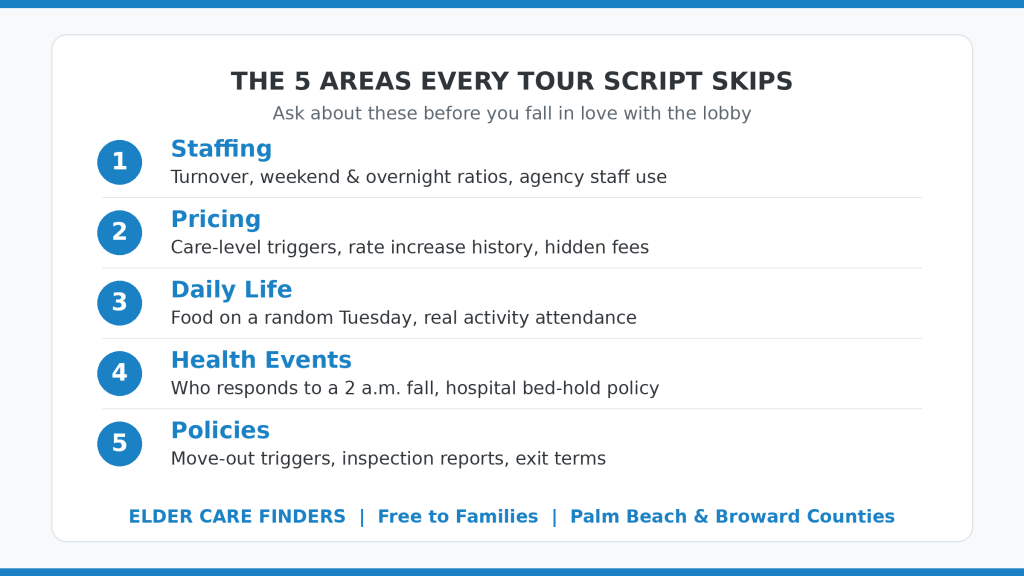
After decades of guiding families through senior community tours across Palm Beach County and Broward County, these are the 15 questions to ask when touring assisted living that families almost always forget — grouped by the five areas where the glossy tour and the daily reality most often diverge.
1. "What was your caregiver turnover in the past 12 months?"
Consistent caregivers learn a resident's habits, moods, and warning signs. A community that churns through staff cannot deliver consistent care no matter how beautiful the lobby is. A confident community will give you a number. A vague answer — "about industry average" — is itself an answer.
2. "What is the staff-to-resident ratio on weekends and overnight — not just during the day?"
Tours happen on weekday mornings, when staffing is at its peak. Your parent will live there on Saturday nights too. Ask specifically for evening, overnight, and weekend ratios, and whether a nurse is in the building or on call during those hours.
3. "How often do you use agency or temp staff?"
Heavy reliance on outside agency staff means unfamiliar faces delivering intimate care. Occasional agency use is normal; routine dependence signals a retention problem the turnover number may be hiding.
4. "Exactly what triggers a move to a higher care level — and who decides?"
Most communities price in care levels or points. The advertised rate is the entry level. Ask what specific changes — medication management, mobility help, incontinence care — bump a resident to the next tier, how much each tier costs, and whether the family is consulted before the increase takes effect. This is the number-one source of billing surprises we see.
5. "What were your rate increases in each of the last three years?"
Not "do rates increase" — every community's rates increase. You want the history: 3% a year is planning; 8–10% a year can price a family out of a home their parent has settled into. Communities know these numbers precisely. Ask for them.
6. "What is not included in the base rate?"
Cable, phone, transportation to appointments, incontinence supplies, salon services, guest meals, medication packaging fees — à la carte charges can quietly add hundreds a month. Ask for the full ancillary fee schedule in writing.
7. "Is the community fee refundable — and under what conditions?"
Most communities charge a one-time move-in or "community" fee that can run into the thousands. Some refund it partially if a resident leaves within a set window; many don't. Get the policy in writing before you sign anything.
8. "Can we come back and eat lunch here — unannounced, on a weekday?"
Tour-day dining is the community at its best. The real test is the food, service, and atmosphere on a random Tuesday. A community confident in its kitchen will welcome the visit. Hesitation tells you something. While you're there, watch whether staff know residents by name.
9. "Can we see attendance numbers for the activities on this calendar?"
A packed activity calendar means nothing if four residents show up. Ask which activities residents actually attend, and visit one in progress. Engaged residents — not laminated calendars — are the sign of a real community.
10. "What happens when a resident stops coming to meals or activities?"
This is the question that reveals whether a community truly watches over its people. Is there a system that flags withdrawal — often the first sign of illness or depression — and who follows up, how quickly, and who calls the family?
11. "Who responds to a fall at 2 a.m. — and what happens next?"
Walk through the scenario step by step: who assesses, whether a nurse is on site or on call, when 911 is called, and when the family is notified. The quality of the answer tells you how rehearsed — or improvised — their emergency response really is.
12. "If my parent is hospitalized, do you hold their apartment — and at what cost?"
Hospital stays happen. Ask how long the community holds the room, whether full rent is charged during the absence, and what the readmission process looks like — some communities require a new care assessment before allowing a resident to return.
13. "What conditions would require my parent to move out?"
Every assisted living license has limits. Communities can and do issue discharge notices when a resident's needs exceed what they're licensed or staffed to provide — advanced dementia, two-person transfers, and wandering are common triggers. Ask for the specific list, in writing, so you know how much "aging in place" this community can actually support. If cognitive decline is part of your family's picture, this is also the moment to ask whether the community has a dedicated memory care wing — and if not, our memory care placement team can help you evaluate communities that do.
14. "May we see your most recent state inspection report?"
In Florida, assisted living facilities are inspected by the state, and survey results are public. A community with a clean record will hand it over proudly. You can also ask how they addressed any past citations — a thoughtful answer about a fixed problem is worth more than a defensive one about a perfect record.
15. "What is your notice period and refund policy if we choose to leave?"
Families ask endless questions about moving in and almost none about moving out. Ask how much notice is required, how prepaid rent is refunded, and what fees apply — because the right community should feel like a choice you're free to keep making, not a contract you're trapped in.
Here's the honest truth: even armed with all 15 questions, most families can't fully evaluate the answers. Is 40% turnover high for this market? Is that rate-increase history normal? Is this community's discharge policy stricter than the one across town? Context is everything — and context is exactly what a senior placement advisor brings.
At Elder Care Finders, our advisors know the communities across Palm Beach County and Broward County personally — their real staffing, real pricing histories, and real reputations, not just their tour scripts. We coordinate and accompany families on tours, ask exactly these questions (and hear the difference between a good answer and a rehearsed one), and our assisted living placement services are completely free to families — we're compensated by communities, never by you. From Boca Raton to Jupiter, we've already done the vetting that a one-hour tour can't.
If you're beginning this journey, our article on how senior placement agencies help families explains what working with an advisor looks like step by step, and our guide to senior placement in Palm Beach County covers the local landscape in depth.
Before your next tour, contact Elder Care Finders — and walk in with an advocate who already knows the answers to the questions the tour won't volunteer. Our guidance is always free to families, from the first conversation through move-in day and beyond.
The material contained on this site is for informational purposes only and DOES NOT CONSTITUTE THE PROVIDING OF MEDICAL ADVICE, and is not intended to be a substitute for independent professional medical judgment, advice, diagnosis, or treatment. Always seek the advice of your physician or other qualified healthcare providers with any questions or concerns you may have regarding your health.