If you have started researching senior living for a parent or spouse, you have probably noticed that every community uses slightly different language — and none of them make it easy to compare. This guide walks through the levels of senior care explained in plain terms: what each level actually provides, what it typically costs in South Florida, who it fits, and the very real price of choosing the wrong one. At Elder Care Finders, we have helped families make this exact decision for more than 17 years — and our senior living placement service is always free to families, because communities compensate us, never you.
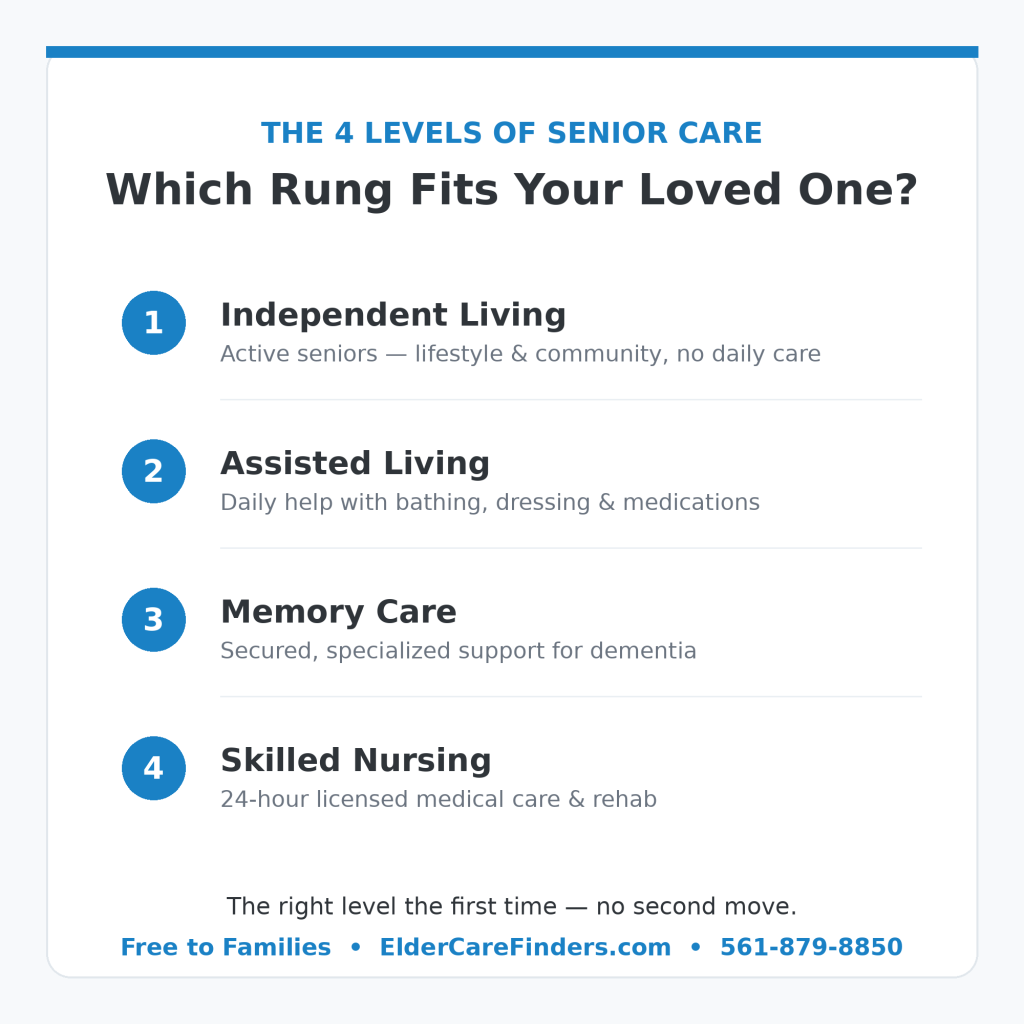
Think of senior care as a ladder with four rungs. Each step up adds more hands-on support — and more cost. The goal is not to climb as high as possible. The goal is to land on the rung that matches your loved one's needs today, with a realistic eye on the next 12–24 months.
Independent living communities are built for active seniors who can manage daily life on their own but want to trade home maintenance for convenience and connection. Residents live in private apartments or cottages with access to dining, fitness centers, transportation, social activities, and 24/7 security.
What it provides: housing, meals, amenities, activities, and maintenance-free living — but no personal care or medical services.
Who it fits: seniors who cook, bathe, dress, and manage medications independently, but who are isolated at home or tired of managing a house.
Typical South Florida cost: roughly $2,500–$4,500 per month, depending on location and amenities.
Assisted living is the middle rung — and the level most families in Palm Beach County and Broward County end up needing. Residents keep a private apartment but receive scheduled help with the activities of daily living: bathing, dressing, grooming, medication management, housekeeping, and meals.
What it provides: personal care staff around the clock, medication management, dining, housekeeping, and a full activity calendar.
Who it fits: seniors who need reliable daily help with one or more personal care tasks but do not need skilled medical care or a secured environment.
Typical South Florida cost: roughly $4,500–$8,000+ per month, driven by apartment size and the level of care required.
Memory care is designed specifically for seniors living with Alzheimer's disease or another form of dementia. These are secured neighborhoods — often within a larger assisted living community — with higher staffing ratios, dementia-trained caregivers, structured daily routines, and environments designed to reduce confusion and prevent wandering.
What it provides: everything assisted living offers, plus a secured setting, specialized programming, and staff trained in dementia behaviors.
Who it fits: seniors with a dementia diagnosis who wander, experience sundowning, or can no longer be safely redirected in a standard assisted living setting.
Typical South Florida cost: roughly $6,000–$9,000+ per month — generally 20–30% above comparable assisted living.
Skilled nursing facilities (often called nursing homes) provide 24-hour medical care delivered by licensed nurses under physician oversight. This level exists for seniors with complex medical conditions — wound care, IV therapy, feeding tubes, ventilator support — or for short-term rehabilitation after a hospital stay.
What it provides: licensed nursing care around the clock, rehabilitation therapies, and medical management that no other level can legally deliver.
Who it fits: seniors whose medical needs exceed what assisted living or memory care staff are permitted to provide.
Typical South Florida cost: roughly $10,000–$13,000+ per month for long-term private-pay stays, though Medicare covers qualifying short-term rehab and Medicaid may cover long-term care for those who qualify.
Here is the part most guides skip: getting the level wrong is expensive both ways.
Choosing too high: overpaying and under-living. A senior placed in assisted living who only needed independent living can pay $2,000–$3,500 more per month for care they do not use — $24,000 to $42,000 a year — while living in a setting less active than they deserve. Being surrounded by residents with greater needs can accelerate decline in a senior who was still thriving.
Choosing too low: the second move within a year. The opposite mistake is more common — and harder on everyone. A family stretches to keep Mom "as independent as possible," and within months the community issues a notice that her needs exceed what they can provide. Now the family faces a second search, a second set of community fees, a second physical move, and a second adjustment period — often during a health crisis. Research on senior transitions consistently shows that each move is disorienting, and for seniors with cognitive decline, a second move within a year can cause a measurable setback. A needs assessment done right the first time is the single best way to avoid it.
When our advisors sit down with a family, we look past the label a community markets and at the questions that actually determine fit:
This is exactly what our senior living placement process is built to do: a complete needs assessment, personalized matching against communities we know firsthand, tours our advisors attend with you, a 5-day transitional support program at move-in, and monthly check-ins after placement. Families across Palm Beach County, Broward County, and the Treasure Coast also gain access to our sister resources — nursing case management, mobile physicians, and private duty home care — as needs change.
You do not have to decode the levels of senior care alone, and you should never pay someone to help you do it. Elder Care Finders has guided South Florida families through this decision for over 17 years, and our placement service is completely free to families — communities compensate us, so you get expert, local guidance at no cost. Call us today at 561-879-8850 and let's find the level of care that fits — the first time.
The material contained on this site is for informational purposes only and DOES NOT CONSTITUTE THE PROVIDING OF MEDICAL ADVICE, and is not intended to be a substitute for independent professional medical judgment, advice, diagnosis, or treatment. Always seek the advice of your physician or other qualified healthcare providers with any questions or concerns you may have regarding your health.