If you are carrying guilt about moving parent to assisted living, start here: the guilt is not evidence that you are doing something wrong. It is evidence of how much you love them. Every week, families sit across from our advisors — a senior living placement service that is always free to families — and say some version of the same sentence: "I feel like I'm betraying her." This article is not going to talk you out of that feeling. It is going to offer you a kinder, more honest way to hold it.
Guilt is what a conscience produces when it believes a duty has gone unmet. For most adult children, the duty they feel is simple and enormous: take care of the person who took care of me. When health, safety, or dementia makes home care impossible, the conscience doesn't automatically update its definition of "taking care of." It keeps grading you against a standard — doing everything yourself, at home, forever — that no longer fits reality.
Here is the kinder truth: caregiver guilt at this moment is nearly universal, and it is almost always misplaced. You are not choosing between caring for your parent and abandoning them. You are choosing between two forms of care — one that is quietly breaking you and one that adds trained hands, safe spaces, and a community to the love you already provide. The love does not stop at move-in day. It changes shape.
Many families are haunted by a specific sentence, spoken years ago at a kitchen table or a hospital bedside: "I'll never put you in a home."
It helps to look honestly at what that promise actually meant when it was made. It was almost never a promise about a building. It was a promise about abandonment — a vow that said, I will not leave you alone, forgotten, in a place where nobody knows your name. That promise was often made with a 1970s or 1980s picture of institutional care in mind: linoleum hallways, shared wards, a television nobody chose.
Today's assisted living communities are a different world — private apartments, restaurant-style dining, activity calendars, and staff trained in senior care and dementia support. When you research communities carefully, tour them, visit often, advocate fiercely, and stay woven into your parent's daily life, you are keeping the real promise. The vow was "I won't abandon you." You aren't.
The most under-told part of this story is what older adults say after the transition. Families brace for permanent unhappiness; what research and community surveys consistently describe instead is an adjustment curve. The first weeks are genuinely hard — homesickness and resistance are normal, and gerontologists even have a name for it: relocation stress. But most residents settle within a few months, and a striking number of families report hearing the sentence nobody expected: "I wish we had done this sooner."
Why? Because the move often replaces things that were quietly shrinking at home — conversation, hot meals eaten with other people, help that arrives without being begged for — and because the adult child gets to become a son or daughter again instead of an exhausted care manager. Visits turn back into visits. Research on later-life moves also points to one factor that shapes adjustment more than almost any other, which brings us to the most important section of this article.
Studies of older adults who relocate consistently find that perceived control predicts wellbeing. Seniors who experience the move as something done with them adjust far better than those who experience it as something done to them. That insight is also the best antidote to guilt, because guilt thrives on secrecy and unilateral decisions.
Including your parent can look like:
When cognitive decline limits how much a parent can participate, inclusion changes form rather than disappearing — honoring known preferences, keeping familiar objects close, and choosing a community with genuine dementia expertise. Families navigating that path can learn more about memory care placement for Alzheimer's and dementia.
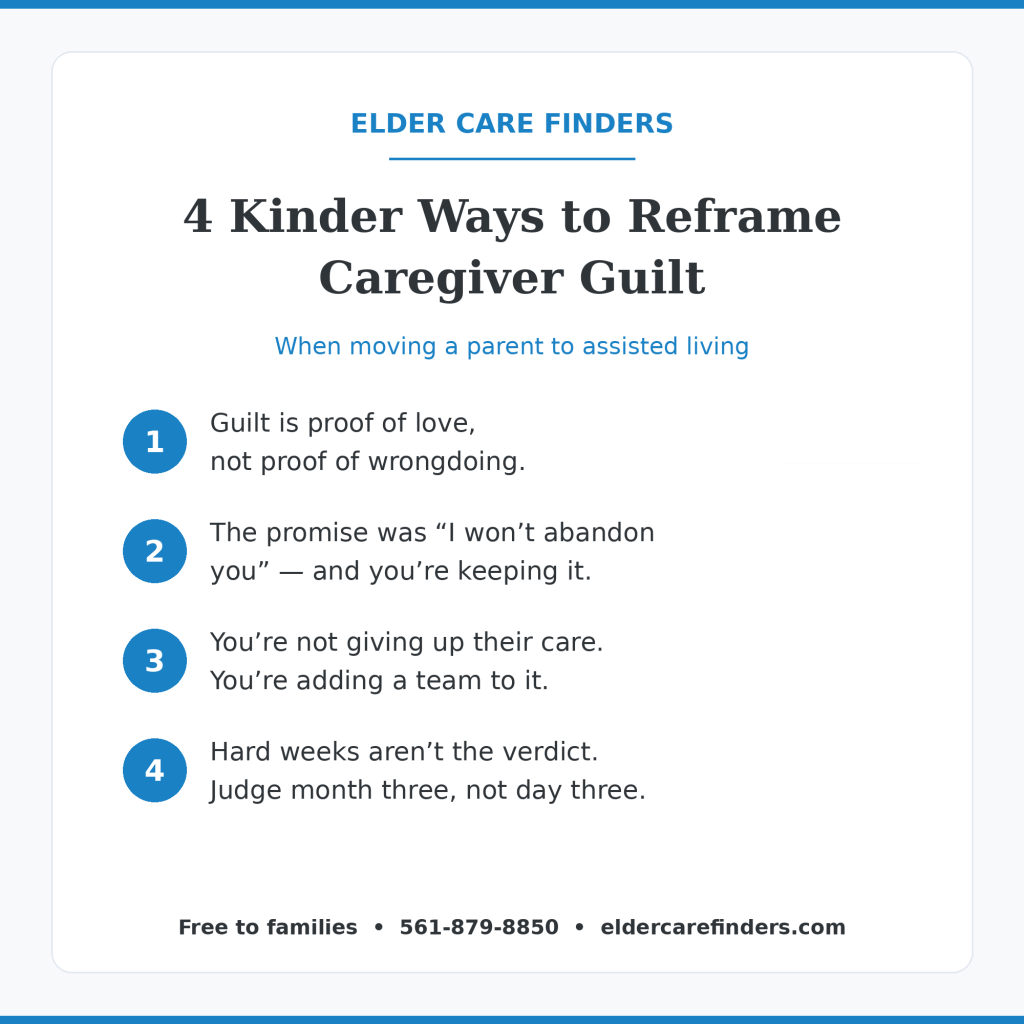
When the guilt surges — and it will, usually at night — try replacing the accusation with one of these truths:
The guilt about moving parent to assisted living softens fastest when the decision is made carefully, together, and with support — and when the practical side of the move is handled well, too. For the logistics of the transition itself, our article on moving a parent to assisted living: emotional and practical tips walks through move-in day and the weeks that follow.
If your family is standing at this crossroads anywhere from Saint Lucie County to Broward County, Elder Care Finders can walk beside you — a needs assessment, personalized community matching, tours we attend with you, a 5-day transitional support program after move-in, and monthly check-ins afterward. Our assisted living placement services in Palm Beach County are, and always will be, completely free to families — communities compensate us, never you. Call 561-617-9320 whenever you're ready to talk it through. There is no wrong time, and no judgment — only someone who has walked hundreds of families through the same tender decision you're facing now.
he material contained on this site is for informational purposes only and DOES NOT CONSTITUTE THE PROVIDING OF MEDICAL ADVICE, and is not intended to be a substitute for independent professional medical judgment, advice, diagnosis, or treatment. Always seek the advice of your physician or other qualified healthcare providers with any questions or concerns you may have regarding your health. Benefit and insurance information is general in nature; eligibility and coverage are determined by your policy and the administering agency.