The first question nearly every family asks us is the one communities are least eager to answer over the phone: what does this actually cost? Because our senior living placement service is free to families — communities compensate us, families never pay a dime — we have no reason to soften the numbers. So here they are: the real assisted living cost South Florida families are paying in 2026, what's included in the rate you see online (and what isn't), how care-level pricing works, and the five ways families actually cover the monthly bill.
Florida's statewide median for assisted living runs roughly $5,000–$5,400 per month in 2026, depending on the survey. But statewide medians blend inland towns with coastal markets — and Palm Beach County and Broward County sit on the higher side of that blend.
Here is what base monthly rates look like by floor plan across Florida communities, based on early-2026 move-in data:
In coastal South Florida — Palm Beach, Jupiter, Boca Raton, Delray Beach, and comparable Broward markets — expect many communities to land between $4,500 and $7,500 per month at the base rate, with luxury communities running $10,000 or more. Couples sharing an apartment typically add a second-person fee of around $1,200 per month, and most communities charge a one-time move-in or "community fee" — the national median is about $3,000.
The number on a community's website is almost never the number on the first invoice. The base rate generally covers the residence, not the care:
Typically included: a private apartment, three daily meals, housekeeping and linen service, utilities, an activity and wellness calendar, scheduled transportation, and 24-hour staff presence.
Typically à la carte or tiered: help with bathing, dressing, and grooming; medication management; incontinence care and supplies; escorts to meals; personal laundry; cable and phone; salon services; guest meals; and medication packaging fees. Individually these look small. Together they can quietly add hundreds of dollars a month — which is why we tell every family to request the complete ancillary fee schedule in writing before signing anything.
Most South Florida communities price care in levels or points. After move-in, a nurse assessment assigns your loved one a care level based on how much daily assistance they need — and that assessment commonly adds $500 to $1,500 per month to the advertised rate. Higher-acuity needs can add $2,000 or more.
Three questions protect your budget before you commit:
These pricing questions pair naturally with the operational ones we cover in our guide to touring senior living communities in Palm Beach County.
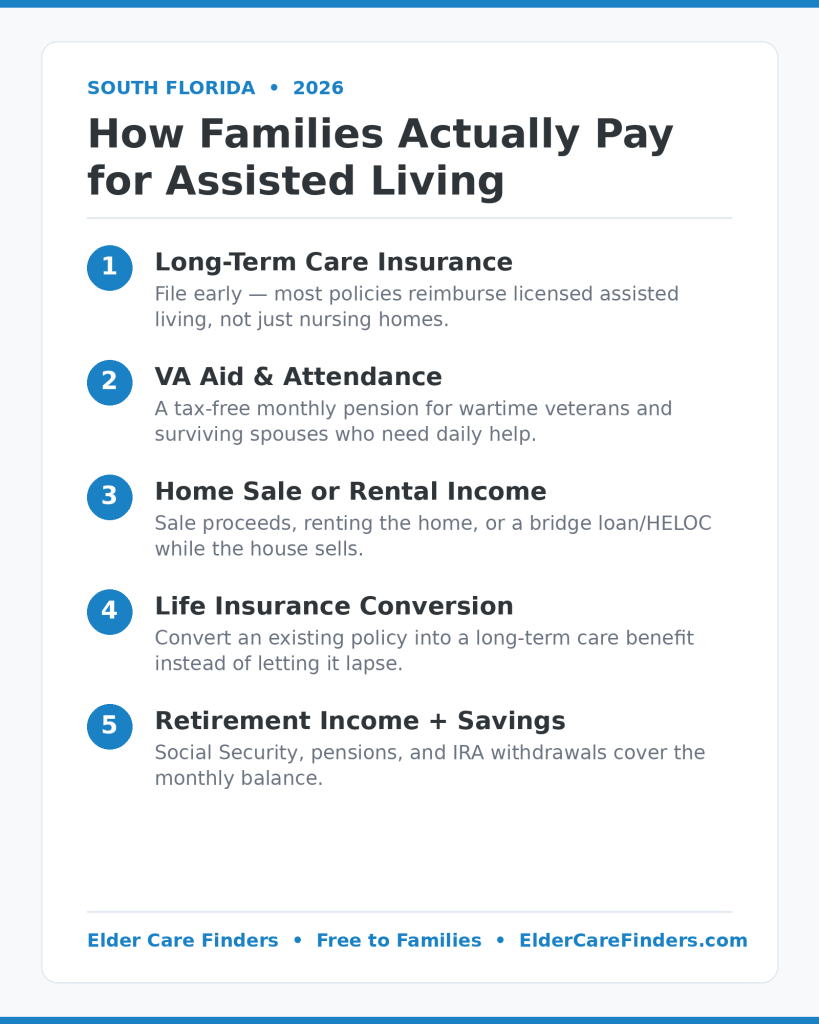
At $60,000–$80,000+ per year, almost no family covers assisted living from a single source. In practice, families combine two or three of the following.
If your loved one owns a long-term care policy, it very likely covers licensed assisted living, not just nursing homes — a fact many families discover late. File the claim early: most policies have an elimination period (often 30–90 days) before benefits begin, and benefits are usually paid as reimbursement. Ask the carrier for the policy's daily or monthly benefit, inflation rider status, and remaining benefit pool before touring.
The most underused benefit in senior care. Wartime veterans and their surviving spouses who need help with daily activities can qualify for a tax-free monthly pension that can be applied directly to assisted living. In 2026, the maximum runs up to roughly $2,424/month for a single veteran, $2,874/month for a veteran with a spouse, and $1,558/month for a surviving spouse, subject to a net worth limit of $163,699 (the primary home and vehicle don't count). Benefits are paid retroactively to the filing date — so filing promptly matters.
For most Palm Beach County families, the house is the largest asset in the plan. Selling it converts equity into years of coverage. When the timing doesn't line up — Mom needs to move before the house sells — families use a bridge loan or HELOC for the gap, or rent the home out to generate steady monthly income instead of selling at all.
A life insurance policy your parent no longer needs doesn't have to lapse. Options include converting it into a long-term care benefit plan that pays the community directly, selling it in a life settlement for a lump sum, or accessing accelerated death benefits if the policy includes that rider. Any of these typically yields far more than the cash surrender value — talk to a licensed advisor before letting a policy go.
Social Security, pensions, and IRA withdrawals form the monthly backbone for most families, with savings covering the balance. Two clarifications save a lot of heartache: Medicare does not pay for assisted living room and board — it covers medical care, not residence. And while Florida's Medicaid long-term care program can help qualifying low-income seniors in some communities, eligibility is strict, not every community participates, and waitlists can stretch many months — it is a safety net to plan toward, not a plan.
Sequencing these sources — what to spend first, what to preserve, when to file — is exactly what our long-term care planning and consulting service walks families through.
National averages get you oriented; they don't tell you what the community two miles from your house charges at care level two. That's where Elder Care Finders comes in. For 17+ years, as part of the Horizon Care Services family, we've helped South Florida families compare real pricing across communities that fit their budget — then accompanied them on tours, asked the fee-schedule questions communities don't volunteer, and supported the move with our 5-day transitional program and monthly post-placement check-ins.
Our assisted living placement service is completely free to families — communities compensate us, so you get an experienced advocate at no cost. We serve families from Saint Lucie County to Broward County, including Palm Beach, Jupiter, Palm Beach Gardens, Boca Raton, Delray Beach, Boynton Beach, and Tequesta. Contact Elder Care Finders today for a free consultation — and get honest numbers before you tour.
The material contained on this site is for informational purposes only and DOES NOT CONSTITUTE THE PROVIDING OF MEDICAL ADVICE, and is not intended to be a substitute for independent professional medical judgment, advice, diagnosis, or treatment. Always seek the advice of your physician or other qualified healthcare providers with any questions or concerns you may have regarding your health.