Published by Elder Care Finders | Senior Living Placement
There are very few decisions a family will ever face that carry the weight of this one. Choosing a senior community for a parent or loved one touches everything at once — their safety, their happiness, their dignity, their daily life, and the peace of mind of everyone who loves them. It is a decision that deserves careful thought, honest conversation, and the right guidance from people who understand the landscape.
The challenge is that the senior living landscape is genuinely complex. There are multiple types of communities, varying levels of care, wide ranges in cost, and meaningful differences in quality from one facility to the next — even among communities of the same type. Families navigating this process for the first time are often overwhelmed, not because the decision is impossible, but because they do not yet have the framework to evaluate their options clearly.
This guide is designed to provide that framework. Whether your loved one is approaching the point of needing assisted living placement, is showing signs of cognitive decline that may require memory care, or simply wants to transition to a community that supports an active senior lifestyle, the steps to finding the right fit are the same — and understanding them makes the entire process significantly less stressful.
The most important starting point is understanding what your options actually are. Senior living communities are not one-size-fits-all, and the differences between them are not just cosmetic. Each type of community is designed to serve a different level of care need, and choosing the wrong category — even an excellent facility in the wrong category — will not serve your loved one well.
Independent Living communities are designed for active seniors who are largely self-sufficient but want the convenience, social engagement, and maintenance-free lifestyle that community living provides. Residents typically live in private apartments or cottages, have access to dining, fitness, and social programming, and do not require daily personal care assistance. Independent living is the right choice for seniors who are physically and cognitively capable but ready to simplify their lives and build new connections.
Assisted Living provides a step up in care. These communities offer housing, meals, social programming, and daily personal care assistance — help with bathing, dressing, grooming, medication management, and mobility. Assisted living is appropriate for seniors who need some support with activities of daily living but do not require the intensive supervision of a memory care or skilled nursing setting. It is one of the most common placements Elder Care Finders helps families navigate, and understanding the wide range of quality and services within the assisted living category is essential to making a good match. Our dedicated page on assisted living placement services covers this in detail.
Memory Care communities are specifically designed for seniors living with Alzheimer's disease, dementia, or other forms of significant cognitive impairment. These communities offer secured environments that prevent wandering, staff trained in dementia-specific care techniques, structured daily routines that reduce anxiety, and programming designed to support cognitive wellness. Memory care is not simply a higher level of assisted living — it is a fundamentally different environment built around the specific needs of cognitively vulnerable residents. Families trying to decide between these two options can find a comprehensive breakdown in our article on memory care vs. assisted living.
Continuing Care Retirement Communities (CCRCs), sometimes called Life Plan Communities, offer a full continuum of care on a single campus — from independent living through assisted living, memory care, and skilled nursing. Residents can age in place without relocating as their care needs change. CCRCs typically require an entrance fee in addition to monthly fees and are best suited for seniors and families who want long-term planning certainty and the security of knowing that care will be available whatever the future holds.
Nursing Homes provide the highest level of residential care, appropriate for seniors with complex medical needs, post-acute rehabilitation requirements, or conditions that cannot be safely managed in an assisted living setting. Nursing homes are licensed and regulated differently from assisted living and memory care communities, and they are staffed with licensed nurses around the clock.
Choosing the right senior community requires an honest, accurate assessment of where your loved one is right now — not where they were a year ago, and not where you hope they might be. Families sometimes underestimate care needs out of a desire to preserve a senior's independence, or overestimate them out of caution. Both errors lead to poor placement decisions.
The assessment should cover several dimensions. Physical care needs — can your loved one bathe, dress, and manage their personal hygiene independently? Are they managing their medications correctly? Do they have fall risk factors that require supervision or physical assistance? Cognitive status — are there signs of memory loss, confusion, or disorientation that go beyond normal aging? Is your loved one safe living without constant supervision? Medical conditions — are there chronic conditions that require regular nursing oversight, specialized wound care, or other skilled medical services?
Social and emotional wellbeing is equally important and often overlooked. A senior who is isolated, depressed, or disconnected from meaningful activity is not thriving, even if their physical and medical needs are being met. The right community should offer programming, social engagement, and an environment where your loved one can build relationships and find purpose.
If your family is uncertain about the appropriate level of care, working with a senior care advisor who can conduct a professional needs assessment is enormously valuable — and it is exactly the starting point Elder Care Finders uses for every family we serve.
Touring a senior living community is not a passive experience. The community's marketing team will present their best version of the facility — and many communities are genuinely excellent. But the questions you ask, and the things you observe beyond the sales presentation, are what will tell you whether this is the right place for your loved one.
Staffing is the single most important factor in the quality of day-to-day care. Ask about staff-to-resident ratios during both day and night shifts. Ask how staff are trained, how long they have been with the community, and how turnover is managed. Consistency of caregivers — residents seeing the same faces every day — is one of the strongest predictors of care quality and resident wellbeing.
Observe the residents themselves. Are they engaged, well-groomed, and interacting with each other and with staff? Or are they sitting quietly in front of a television with little stimulation? The atmosphere of a community tells you far more than its brochure.
Ask about programming and activities. A strong activities calendar that reflects residents' actual interests — not just bingo and movie nights — is a sign that the community takes resident wellbeing seriously. For memory care communities specifically, ask how activities are adapted for residents at different stages of cognitive decline.
Ask about the handling of health changes. What happens when a resident's care needs increase? Is there a pathway to a higher level of care within the same community, or will your loved one need to relocate? For families choosing a community for the long term, this question is critical.
Ask about costs and what is included. Senior community pricing is often structured in layers — a base monthly fee plus additional charges for various care services. Understanding exactly what is and is not included in the base rate, and what additional costs might be triggered as needs change, is essential to avoiding financial surprises. Our article on moving to senior living — a checklist for seniors and families covers many of the logistical and financial considerations families should address before and during the transition.
No amount of objective information fully captures whether a senior community is the right fit for a specific person. Fit is partly about care levels and amenities, but it is also about culture, personality, lifestyle, and the intangible sense of whether this is a place where your loved one will be happy.
Consider your loved one's social preferences. Are they naturally outgoing and likely to thrive in a highly social, activity-rich environment? Or are they more introverted and likely to prefer a quieter community with opportunities for connection that do not require constant participation? Consider their interests and hobbies — does the community offer programming that speaks to what they actually care about?
Consider the cultural and social composition of the resident population. Your loved one will be building relationships with the people who live there. Does the community's resident population reflect a group they would genuinely connect with?
Consider location. Proximity to family members who will visit regularly matters enormously for resident wellbeing and family peace of mind. A community that is difficult to reach will result in fewer visits, and fewer visits affect emotional health in ways that are measurable and significant.
One of the most common challenges families face is not choosing the wrong community — it is waiting too long to start the process at all. Many families begin exploring senior living options only after a crisis has forced the issue: a fall, a hospitalization, a safety incident at home, or a sudden escalation in a loved one's care needs. At that point, decisions are being made under pressure, without the time to tour multiple communities, ask the right questions, and make a truly considered choice.
The earlier a family begins the exploration process, the better. You do not need to be ready to move to start gathering information. Understanding what options exist, what they cost, and what the process looks like allows you to make a planned, thoughtful decision rather than a reactive one. Our article on 5 signs it's time to explore senior living options provides a practical framework for recognizing when the conversation should begin.
The signs that exploration is warranted include increasing difficulty with daily tasks, safety concerns at home, social isolation, cognitive changes that are affecting function and safety, caregiver burnout in family members providing support, and a senior's own expressed desire for more community and connection.
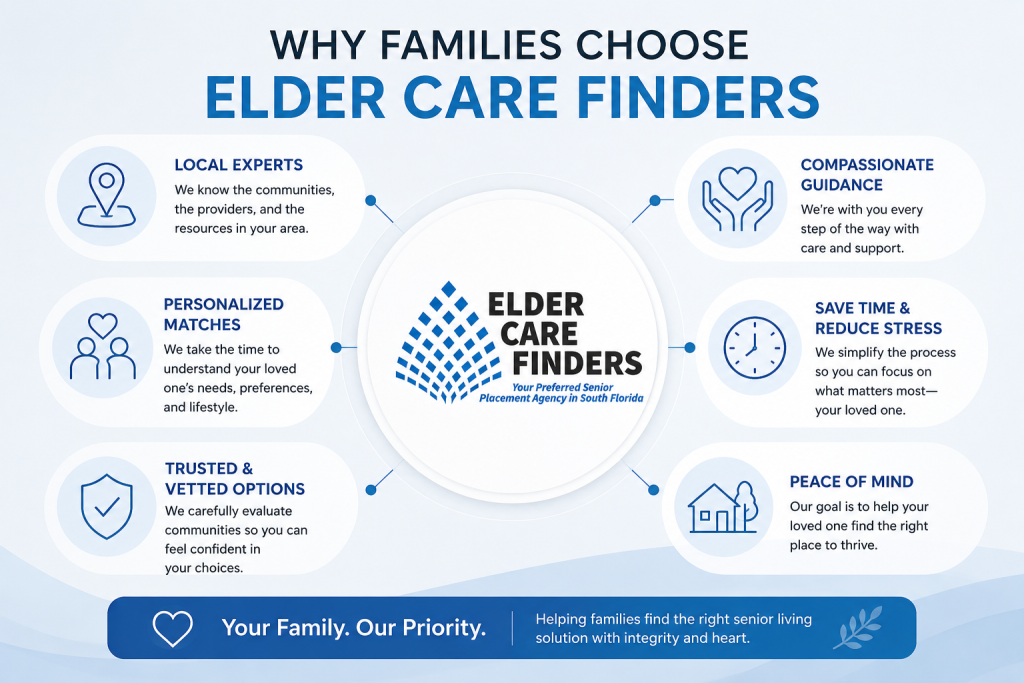
Navigating the senior living placement process without expert guidance means relying on facility marketing materials, online reviews, and whatever information you can gather during a handful of tours. It means not knowing which communities in Palm Beach County and across South Florida have strong inspection records and consistent staffing, and which ones do not. It means not having a professional advocate who knows the local market and can match your loved one's specific needs with the communities that are actually likely to serve them well.
Elder Care Finders has spent over 17 years building exactly that expertise. Our senior care advisors know the communities across Palm Beach, Martin, and St. Lucie Counties at a level that families simply cannot replicate through independent research. We have visited these communities, built relationships with their leadership, and tracked their quality over time.
Our placement process begins with a thorough needs assessment — a direct, honest conversation about your loved one's care requirements, preferences, budget, and goals. From there, we develop a personalized shortlist of communities that genuinely fit. We coordinate and accompany you on tours, help you ask the right questions, guide you through the comparison process, and support the paperwork and logistics of move-in. After placement, our team continues to check in — monthly visits and ongoing family communication ensure that the placement is working and that any changes in care needs are addressed proactively.
And our services are provided at no cost to families. Elder Care Finders is compensated by the communities we work with, which means you receive expert, personalized guidance through one of the most important decisions you will ever make — without any out-of-pocket cost.
For families across West Palm Beach, Palm Beach Gardens, Boca Raton, Jupiter, Stuart, and throughout South Florida, Elder Care Finders is the partner that makes finding the right senior community less overwhelming and more certain.
Ready to start the conversation? Contact Elder Care Finders today at 561-879-8850 or visit our website to speak with a senior care advisor. We are available seven days a week and are ready to help your family find the right fit — with compassion, expertise, and no cost to you.
Elder Care Finders provides senior living placement services across Palm Beach, Martin, and St. Lucie Counties in South Florida. This article is for informational purposes only and does not constitute medical or legal advice. Always consult qualified professionals regarding your loved one's individual care needs.