
Moving to a senior living community changes where a person lives, but it should not erase the routines, relationships, and preferences that make life feel familiar.
Elder Care Finders provides personalized senior living placement in Lake Worth Beach, FL, helping families explore independent living, assisted living, memory care, and qualifying respite or short-term community stays.
Our local advisors learn about the senior’s current support needs, personality, preferred location, daily lifestyle, and budget before recommending communities. We help coordinate tours, organize comparisons, and support the family through the selection and transition process.
Placement assistance is provided at no cost to families. Call (561) 879-8850 to begin your search.
Families frequently use “Lake Worth” to describe both the City of Lake Worth Beach and the larger surrounding area. For a senior living search, understanding that distinction can be important.
A family may want a community close to downtown Lake Worth Beach, the historic neighborhoods surrounding Lake and Lucerne avenues, or relatives living near the coast. Another senior may be more comfortable farther west, closer to established physicians, friends, shopping, or adult children.
The right location is not always determined by the city name in the mailing address. Driving time, transportation, family access, and the senior’s established routine may matter more.
Elder Care Finders helps families consider communities throughout the greater Lake Worth area and, when appropriate, nearby Boynton Beach or West Palm Beach.
This broader view can provide more choices while keeping the senior close to the people and places that matter.
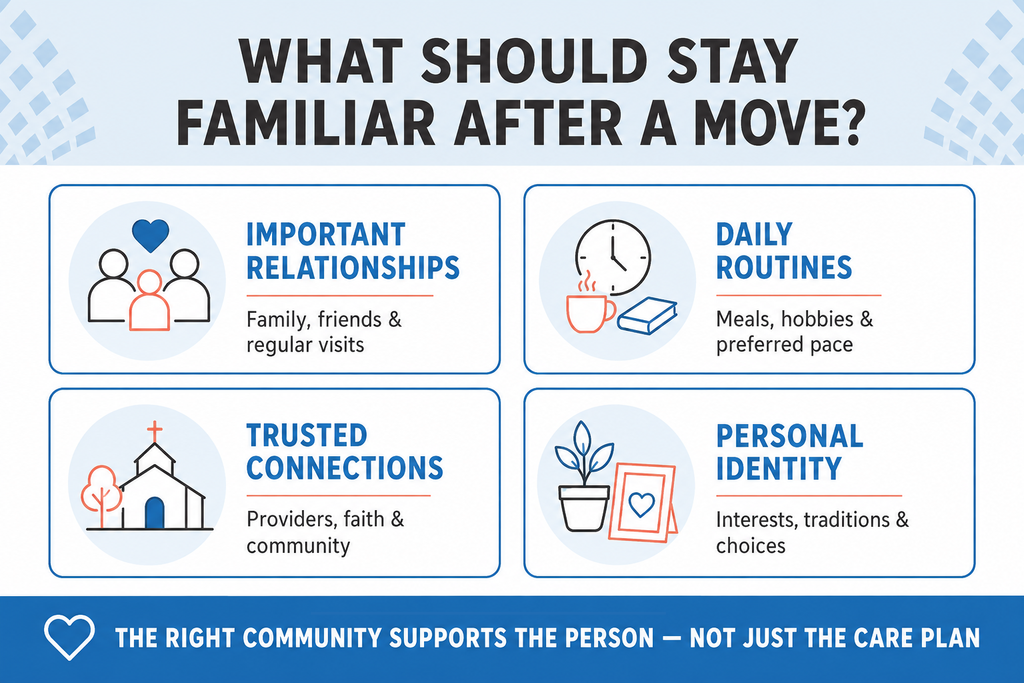
Families naturally focus on what will change: the home, the address, the apartment size, and the people providing daily support. It is equally important to identify what the senior hopes will stay the same.
A successful placement should preserve as much familiarity and personal control as reasonably possible.
How close will the senior be to adult children, grandchildren, longtime friends, or a spouse who lives elsewhere? A community may appear suitable on paper but become impractical if the people most likely to visit face a difficult drive.
Regular visits can be especially important during the first weeks after a move. Location should be evaluated according to the family’s actual travel patterns—not simply distance measured in miles.
Consider how the senior prefers to spend an ordinary day.
Some people enjoy organized activities, shared meals, and frequent conversation. Others value privacy, quiet mornings, independent schedules, and small-group interaction.
Ask whether the community’s normal routine resembles the lifestyle the senior already enjoys. A long list of amenities has little value if the resident is unlikely to use them.
Moving to senior living does not necessarily mean changing every established healthcare provider. Families may want to consider the distance to the senior’s existing physicians, preferred pharmacy, therapy providers, or other regular appointments.
Transportation policies should also be reviewed. Ask where the community provides transportation, how far in advance it must be scheduled, and whether additional fees apply.
A senior is more than a list of care requirements.
Personal interests, cultural traditions, religious practices, favorite foods, pets, hobbies, and preferred social environment can all affect whether a community feels comfortable.
Elder Care Finders considers these details when developing personalized community recommendations.
Before touring communities, the family should decide which requirements are essential and which preferences are flexible.
A non-negotiable may involve safety, required assistance, budget, or proximity to the person who will provide the most family support. Preferences such as apartment layout, décor, or certain amenities may be important but more flexible.
The family’s non-negotiables might include:
Defining these requirements early prevents attractive but unsuitable communities from distracting the family from its priorities.
Elder Care Finders specializes in matching families with senior living communities based on the individual senior’s circumstances.
Independent living communities may be appropriate for active older adults who manage their personal needs but want a more convenient and social lifestyle.
Services vary but may include dining, housekeeping, transportation, activities, maintenance, fitness programs, and access to shared spaces. Families should compare what is included in the monthly rate and whether outside or additional support can be arranged if needs change.
Assisted living placement may be considered when a senior needs assistance with bathing, dressing, grooming, meals, medication management, mobility, or other daily activities.
Communities differ in the amount of assistance they provide and how they calculate care charges. Families should ask how residents are assessed, what services are included, and how costs may change if the resident requires additional support.
Memory care placement is intended for individuals living with Alzheimer’s disease or another form of dementia who need increased structure, security, and supervision.
Families should evaluate staff training, daily routines, resident engagement, overnight coverage, secured outdoor areas, family communication, and the community’s approach to changing behaviors or support needs.
Clinical decisions about the appropriate care setting should be discussed with the senior’s qualified healthcare professional.
Some communities offer qualifying respite or short-term stays, depending on availability and admission requirements.
A temporary stay may provide support while a family caregiver is unavailable or allow a senior to experience community living before making a longer-term decision. Short-term pricing, included services, furnished accommodations, and length-of-stay requirements vary by community.
Elder Care Finders does not provide nursing-home or skilled-nursing placement.
The decision to explore senior living is not always caused by one dramatic event. Often, several smaller changes begin to accumulate.
The home may require more upkeep than the senior can manage. Driving may become stressful. Meals may become less regular. Social interaction may decrease. An adult child may gradually assume more responsibility for medications, transportation, shopping, and personal care.
Families may notice:
These signs do not automatically mean that a senior must move immediately. They do indicate that the family may benefit from understanding the available options.
Our long-term care planning and consulting can help families begin the conversation before an urgent situation limits their choices.
During tours, families often receive large amounts of information in a short period. Apartments, menus, activity calendars, care plans, fees, and contract terms can quickly blend together.
Bring the senior’s non-negotiables to every visit and use them as the basis for comparison.
Observe how staff members interact with residents. Look at the shared spaces during an ordinary part of the day. Ask to review the current activity calendar and sample menu. Find out how transportation works and what support is available overnight.
Request clear written information about:
Elder Care Finders helps families organize this information so they can compare communities according to consistent priorities.
The senior and family remain responsible for the final decision. Our role is to provide personalized recommendations, local information, and practical placement support.
Our senior living placement services begin with a conversation about the senior and family.
We identify the type of community that may be appropriate, focus the search on realistic options, help coordinate tours, and prepare families with questions to ask.
After tours, we help the family compare services, pricing structures, policies, living environments, and location considerations. Once the family selects a community, we remain available during the move-in coordination process.
Elder Care Finders also provides a five-day transitional support program following move-in. Post-placement communication and monthly family check-ins offer continued support as the senior becomes familiar with the new environment.
Senior living pricing varies based on location, apartment type, included amenities, and the amount of assistance required.
Families should avoid comparing communities solely by the advertised starting rate. One community may include dining, housekeeping, transportation, and certain services in its monthly charge, while another may bill separately for many of those items.
Ask every community for a written estimate of the expected monthly cost based on the senior’s current needs.
It is also important to understand how often rates may increase, how care-level changes are calculated, and which one-time fees are due before move-in.
Elder Care Finders helps families identify the expenses and policies they should compare. Each community independently establishes its pricing, availability, assessments, and admission requirements.
Elder Care Finders’ placement assistance is provided at no cost to families. When a placement is completed with a participating senior living community, that community compensates our agency.
Elder Care Finders is a senior living placement agency. We are not a senior living community, home-care provider, medical provider, nursing home, or emergency service.
The right senior living community should provide appropriate support without losing sight of the senior’s identity, relationships, and daily preferences.
Elder Care Finders helps families explore senior living in Lake Worth Beach and the surrounding Lake Worth area. We narrow the search, coordinate tours, help families compare important information, and provide transition support—all at no cost to families.
Call (561) 879-8850 or contact Elder Care Finders online to begin your search.