Finding the right living arrangement for an aging parent can feel overwhelming. Families must consider safety, independence, health, memory, social connection, location, and cost—often while navigating strong emotions or responding to an unexpected change.
Elder Care Finders helps families understand senior housing options for elderly parents and identify communities that fit each person’s needs, preferences, and budget. We assist with independent living, assisted living, memory care, skilled nursing and rehabilitation resources, and available respite or short-term stays throughout Palm Beach, Martin, and St. Lucie counties.
Our local advisors guide families from the first conversation through community comparisons, tours, selection, move-in, and follow-up. Senior living placement assistance is provided at no cost to families.
Call Elder Care Finders at (561) 879-8850 to schedule a free consultation.
Before comparing buildings, floor plans, or amenities, consider how your parent manages daily life. The most appropriate option depends on what is happening now and what may change over the next several months.
Important questions include:
One concern does not automatically mean a parent must move. It does mean the family should assess the situation carefully and understand the available choices before an emergency limits those choices.
Some older adults can continue living safely at home with the right support. Others may benefit from a community that provides greater social connection, personal assistance, supervision, or access to care.
Remaining at home may be appropriate when the residence is safe and accessible, care needs are manageable, reliable help is available, and the senior remains connected and engaged.
Families should consider:
Elder Care Finders specializes in senior living placement. If remaining at home appears appropriate, families should consult qualified home-care, healthcare, legal, and financial professionals as needed.
A senior living community may be worth considering when a parent is no longer safe alone, needs consistent help with daily activities, is experiencing memory changes, or would benefit from meals, transportation, activities, and a more connected environment.
A move may also become necessary when family caregivers can no longer provide the required level of support or when the current home cannot reasonably accommodate changing needs.
The decision should be based on the individual—not on age alone.
Senior housing terms can be confusing. These are the most common options families may encounter.
Independent living communities are generally designed for active older adults who can manage daily life without routine personal assistance but want a maintenance-free and more social lifestyle.
Services may include dining, housekeeping, transportation, activities, and access to shared amenities. Independent living typically does not include help with bathing, dressing, or medication management.
Assisted living may be appropriate for a parent who needs help with daily activities such as bathing, dressing, grooming, medication management, meals, or mobility.
Care capabilities and pricing vary significantly. Families should ask what assistance is available, how needs are assessed, what generates additional charges, and whether the community can accommodate increasing care needs.
Memory care supports people living with Alzheimer’s disease and other forms of dementia who may benefit from structured routines, specialized programming, increased supervision, and a secured environment.
When comparing memory care, families should consider staff training, resident engagement, safety measures, overnight support, communication practices, and how the community responds to behavioral or cognitive changes.
Skilled nursing or rehabilitation may be appropriate when a parent needs nursing supervision, therapy, recovery support, or services beyond the scope of assisted living. Admission and coverage depend on the person’s clinical needs, the receiving provider, and applicable insurance or benefit requirements.
Elder Care Finders can help families identify appropriate local resources when this service is available, but medical eligibility and coverage decisions are made by healthcare professionals, providers, and insurers.
Some communities offer temporary stays following an illness or rehabilitation period, during a caregiver’s absence, or as an opportunity to experience community living before making a long-term decision.
Availability, admission requirements, minimum stays, and included services vary.
Senior retirement communities may focus on active adult or independent living, while life plan communities may offer several levels of living within one organization or campus. Contracts, entrance fees, monthly charges, and access to higher levels of care should be reviewed carefully.
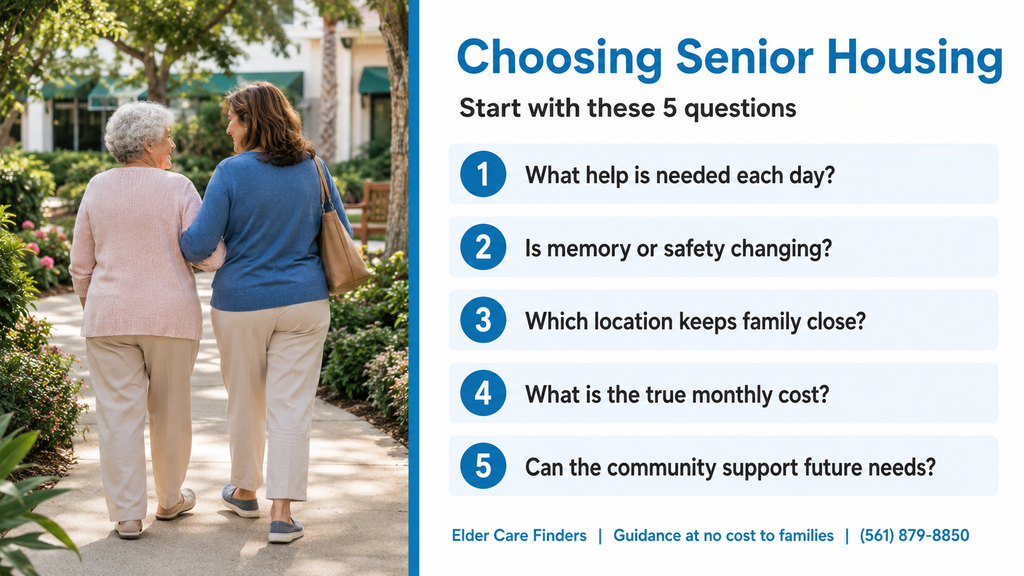
The right choice should support your parent’s needs and personality—not simply look impressive during a tour.
Confirm which services are available and whether they match your parent’s needs. Ask how care levels are assessed, what happens if needs increase, what support is available overnight, and under what circumstances a resident may be required to move.
Observe how staff and residents interact. Look at resident engagement, dining, activity participation, common spaces, and whether the overall atmosphere feels appropriate for your parent.
Consider proximity to involved family members, physicians, hospitals, religious or cultural connections, and familiar neighborhoods. The closest community is not always the right community, but distance can affect visits and family involvement.
Ask for a written breakdown of the base rate, care charges, medication fees, meal plans, transportation, deposits, community fees, and other recurring or one-time expenses. Do not compare communities using advertised starting prices alone.
Families can use Florida’s official FloridaHealthFinder to locate licensed providers and review available facility information. Licensing information is one part of a careful evaluation and should be considered alongside tours, written policies, care capabilities, and professional guidance.
Review rate-increase provisions, deposits, refund policies, care reassessments, move-out terms, and discharge provisions. Obtain all promises in writing and consult a qualified elder law attorney when legal interpretation is needed.
Searching online can produce a long list of communities without explaining which ones are appropriate. Elder Care Finders provides a structured, personalized process.
We learn about your parent’s care needs, lifestyle, personality, preferred location, budget, family involvement, and desired timeline.
Our advisors narrow the search to options that may fit the senior and family. Recommendations are based on individual criteria rather than an unfiltered directory.
We help organize tours and prepare families to compare care, services, pricing, policies, and community atmosphere.
After a community is chosen, Elder Care Finders remains available through admissions and move-in. Our service includes a five-day transitional support program following move-in and post-placement communication, including monthly check-ins with the family.
Learn more about our complete senior living placement services.
Elder Care Finders serves families throughout:
Visit our Service Areas page for more information. Our current placement service area does not include Broward or Miami-Dade County.
Begin by considering how safely your parent manages daily activities, mobility, medication, meals, memory, and emergencies. Elder Care Finders can help your family understand the differences among housing options. Clinical or medical decisions should be made with the appropriate healthcare professional.
Starting the conversation early gives families more time to compare communities, understand costs, involve the senior, and plan the transition. Exploring options does not require making an immediate move.
Yes. We assist adult children and relatives who live elsewhere but need local guidance for a parent in Palm Beach, Martin, or St. Lucie County.
Yes. Senior living placement assistance is provided at no cost to families. When a placement is made with a participating community, that community compensates Elder Care Finders.
No. The senior and family always make the final decision. Our role is to provide personalized recommendations, local information, and practical support.
You do not have to compare every senior housing option alone. Elder Care Finders can help your family understand the appropriate level of support, focus on suitable communities, organize tours, compare important details, and prepare for the transition.
For more than 17 years, we have helped families navigate senior living decisions throughout Palm Beach, Martin, and St. Lucie counties. Our placement assistance is provided at no cost to families.
Call Elder Care Finders at (561) 879-8850 or contact us online to schedule a free consultation.
The material contained on this site is for informational purposes only and DOES NOT CONSTITUTE THE PROVIDING OF MEDICAL ADVICE, and is not intended to be a substitute for independent professional medical judgment, advice, diagnosis, or treatment. Always seek the advice of your physician or other qualified healthcare providers with any questions or concerns you may have regarding your health.