
Choosing a senior retirement community is an important decision that can affect a person’s lifestyle, independence, social connections, and future care options. With many communities available, it can be difficult to determine which setting truly fits your loved one’s needs, preferences, and budget.
Elder Care Finders helps families compare senior retirement communities in Palm Beach County, Martin County, and St. Lucie County. Our local advisors take time to understand the senior’s daily routine, desired location, interests, financial considerations, and anticipated support needs before recommending appropriate options.
Whether your loved one is seeking an active retirement lifestyle, maintenance-free independent living, or a community that offers access to additional care, we can simplify the search and guide your family through each step. Our senior living placement assistance is provided at no cost to families.
Call Elder Care Finders at (561) 879-8850 to schedule a free consultation.
A senior retirement community is a residential setting designed for older adults who want a more convenient, social, or supportive lifestyle. Depending on the community, residents may live in an apartment, condominium, villa, or single-family home.
Some retirement communities focus primarily on active, independent living. Others provide dining, housekeeping, transportation, activities, or access to increasing levels of support. Age requirements, housing arrangements, services, and care capabilities vary, so families should understand exactly what each community provides.
Many older adults consider retirement communities because they want to:
A retirement community should be selected based on the individual—not simply its appearance, location, or list of amenities.
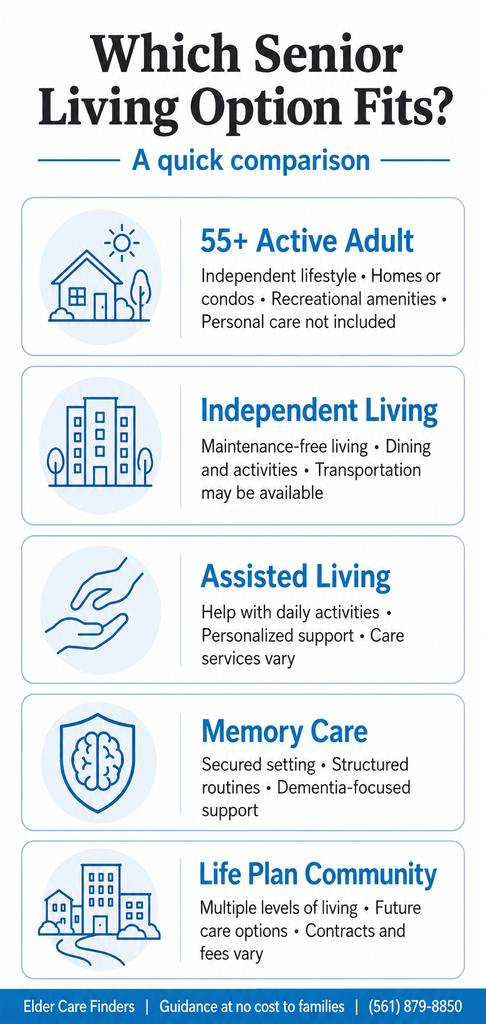
“Retirement community” is a broad term that can describe several different residential models. Understanding the differences helps families avoid choosing a setting that does not provide the lifestyle or support they expect.
Age-restricted active adult communities are generally intended for people who can live independently and want access to recreational amenities and a community of similarly aged neighbors. Housing may include condominiums, villas, townhomes, or single-family residences.
These communities may offer clubhouses, pools, fitness facilities, golf, social clubs, and organized events. Personal care and healthcare services are typically not included, so families should not assume that a 55+ community provides the same support as independent or assisted living.
Independent living communities are designed for older adults who are generally able to manage daily life without routine personal assistance but want a maintenance-free environment with convenient services and social opportunities.
Depending on the community, services may include:
Services vary, and independent living generally does not include assistance with bathing, dressing, medication management, or other daily personal-care needs.
Continuing care retirement communities—sometimes called life plan communities—may offer multiple levels of living within one campus or organization. These can include independent living, assisted living, memory care, and skilled nursing.
This model may appeal to seniors who want to plan for possible future changes without leaving the broader community. However, contracts, entrance fees, monthly charges, eligibility requirements, and access to higher levels of care can vary significantly. Families should review all financial and contractual terms carefully and consult qualified legal and financial professionals when appropriate.
Assisted living may be appropriate when a senior needs help with activities such as bathing, dressing, medication management, mobility, or meals.
Assisted living communities differ from independent retirement communities because they provide personal assistance based on the resident’s assessed needs. Care capabilities and additional charges vary, so families should ask what services are available now and what happens if support needs increase.
Memory care communities support people living with Alzheimer’s disease and other forms of dementia. They may offer secured environments, structured routines, specialized programming, increased supervision, and staff trained to respond to cognitive and behavioral changes.
Families should evaluate staff training, resident engagement, safety measures, communication practices, overnight support, and the community’s ability to accommodate changing needs.
The benefits depend on the community and the senior’s priorities. When the setting is a good match, retirement living may offer:
Activities, shared dining, clubs, classes, and common areas can make it easier to build friendships and stay connected. This can be especially valuable for someone who has become isolated while living alone.
Maintenance, landscaping, and some household tasks may be included, allowing residents to spend less time managing a property and more time on personal interests.
Depending on the community, residents may have access to transportation, dining, fitness programs, educational activities, housekeeping, and recreational spaces.
Features such as accessible layouts, emergency-response systems, staffed common areas, and organized transportation may provide reassurance. Families should confirm which safety and support services are actually included rather than assuming every retirement community offers the same features.
Some communities provide access to additional services or higher levels of care. Families should ask how care needs are reassessed, what added support costs, and whether a future move would be required.
A beautiful community is not automatically the right community. Before making a decision, compare:
Families should request all prices, policies, and promises directly from the community in writing. Legal questions or contract interpretation should be directed to a qualified elder law attorney.
Online directories can show which communities exist, but they do not determine which setting is appropriate for a particular person. Elder Care Finders provides personalized guidance based on the senior’s needs and the family’s priorities.
Our process includes:
We discuss lifestyle preferences, independence, mobility, memory, health concerns, budget, preferred location, and possible future needs.
Our advisors narrow the search to communities that may fit the senior’s criteria. Families receive personalized recommendations instead of an overwhelming generic list.
We help families organize tours and prepare questions about services, pricing, care, contracts, and community life.
Once a community is selected, Elder Care Finders remains available through admissions and move-in. Our service includes a five-day transitional support program after move-in and post-placement communication, including monthly check-ins with the family.
Learn more about our complete senior living placement services.
Elder Care Finders helps families explore senior retirement and senior living communities throughout:
Visit our Service Areas page to explore the locations we serve.
Our current service area does not include Broward or Miami-Dade County.
Costs vary based on location, housing type, amenities, included services, contract structure, and level of care. Some communities charge a straightforward monthly fee, while others may require entrance fees, deposits, association fees, care charges, or other expenses.
Before choosing a community, request a written breakdown that identifies:
Elder Care Finders helps families compare suitable options within their stated budget, but each community establishes its own prices and admission requirements.
Retirement communities often focus on independent, maintenance-free living and social opportunities. Assisted living provides personal assistance with daily activities based on the resident’s assessed needs. Some larger retirement communities offer both options.
No. Age requirements and residency rules vary. Some are legally age-restricted communities, while others are senior living communities designed primarily for older adults without using the same housing model.
It depends on the community. Some provide several levels of care, while others require residents to arrange outside assistance or move if their needs exceed what the setting can support. Ask for this policy in writing before making a decision.
Yes. Our senior living placement assistance is provided at no cost to families. When a placement is made with a participating community, that community compensates Elder Care Finders.
Yes. We assist adult children and other relatives who live elsewhere but need local guidance for a senior in Palm Beach, Martin, or St. Lucie County.
The right retirement community should support the senior’s lifestyle today while giving the family a realistic understanding of future options. Elder Care Finders helps families compare communities, evaluate important differences, and move forward with greater confidence.
For more than 17 years, we have guided families through senior living decisions across Palm Beach, Martin, and St. Lucie counties. Our placement assistance is provided at no cost to families.
Call Elder Care Finders at (561) 879-8850 or contact us online to schedule a free consultation.
The material contained on this site is for informational purposes only and DOES NOT CONSTITUTE THE PROVIDING OF MEDICAL ADVICE, and is not intended to be a substitute for independent professional medical judgment, advice, diagnosis, or treatment. Always seek the advice of your physician or other qualified healthcare providers with any questions or concerns you may have regarding your health.